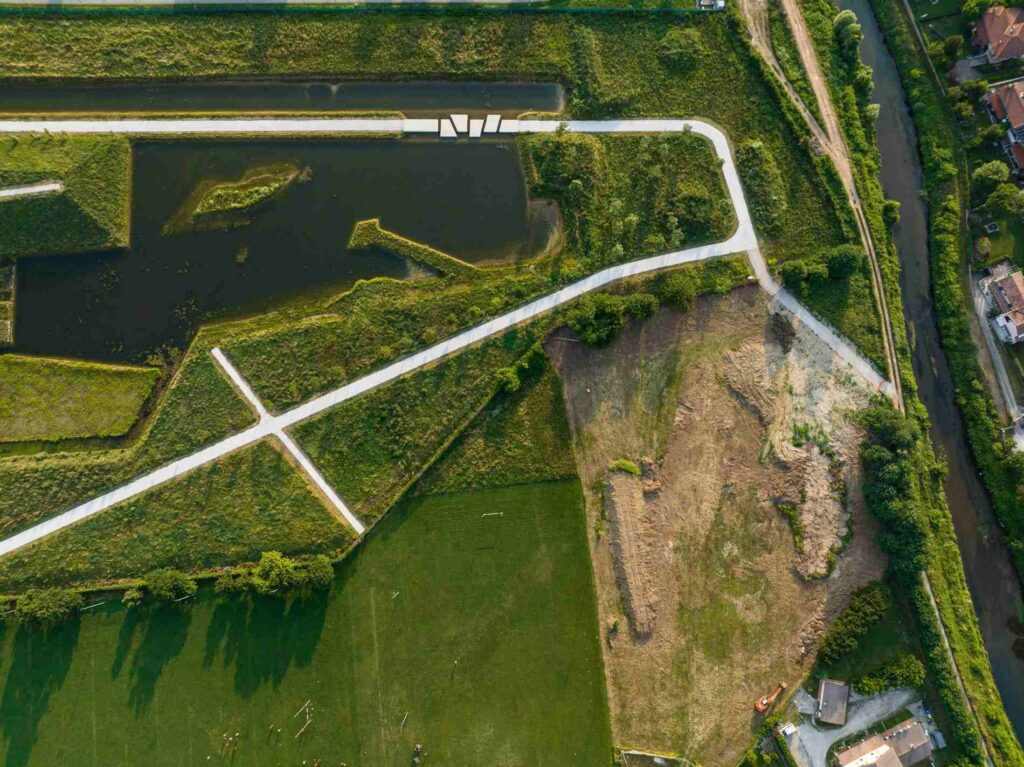
To understand what Ellinikon, on the southern outskirts of Athens, is becoming, let’s start with a figure: 200 hectares. That is the area of the Greek capital’s former international airport, which is set to be transformed into Europe’s largest coastal urban park. It is scheduled to open to the public in early 2027, while the completion of additional infrastructure is planned by 2030.
Euronews, in collaboration with the APE-MPE news agency, reported on the scale and characteristics of the project. Perhaps the most interesting fact is not just how large the park will be, but how it was designed.
From Concrete to Microclimate
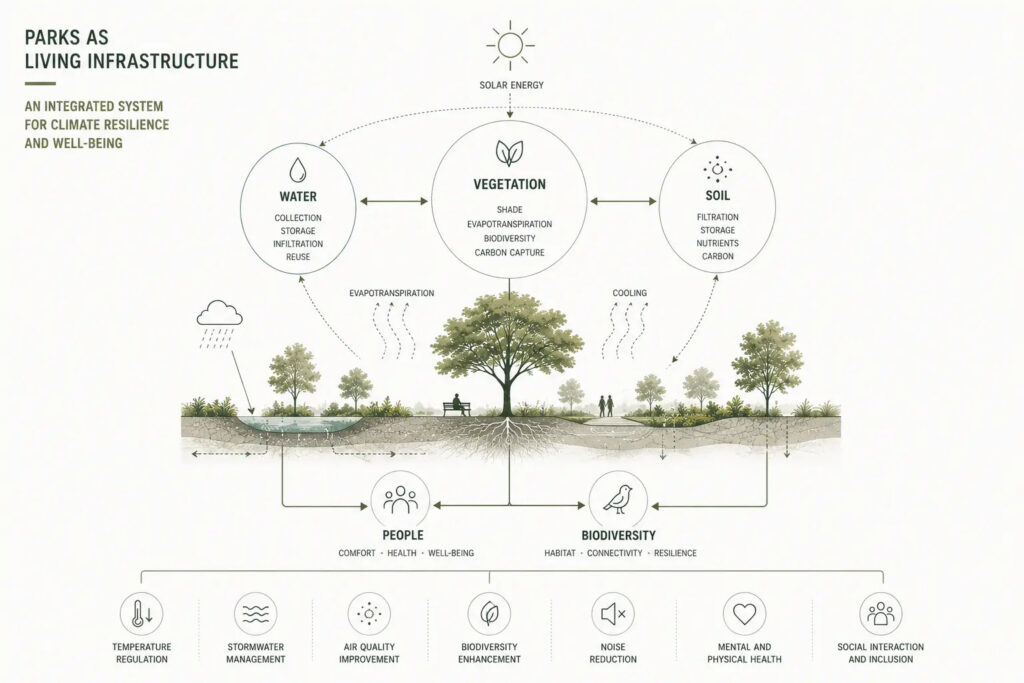
The project calls for more than 30,000 trees and approximately three million shrubs. The vegetation is expected to cover 70% of the area. The stated goal is to create a space capable of influencing local climatic conditions, using shade, vegetation, water, materials, and ventilation as components of the same system.
Digital simulations, thermal mapping, and computational fluid dynamics (CFD) techniques were used to design the microclimate. These analyses also led to the creation of a network of “cool paths,” along which the temperature can be up to four degrees lower than on nearby paved surfaces.
Rest areas will have more than 60% shade, without obstructing natural air circulation. Trees and shrubs will also help cool the area through evapotranspiration. Canals, misting systems, and water-efficient ponds will be integrated into the overall design.
This marks a shift in perspective: green spaces are treated as a functional component of the city.
Water is the deciding factor
In a Mediterranean city facing increasingly hot summers, a park of this size raises a question: how much water will it take to maintain it? Ellinikon is attempting to answer this by designing the water system first. A tertiary treatment plant will be able to produce up to 7,000 cubic meters of treated water per day, intended for permitted non-potable uses, including irrigation. A 10,000-cubic-meter reservoir is also planned.
Irrigation will be managed using weather and soil sensors, which will allow water volumes to be adjusted based on the actual condition of the vegetation. According to the study underlying the project, the system could result in water savings of up to 90%. Rainwater will also be managed within the area through green and blue infrastructure. The project also includes the restoration of the natural flow of the Trachones stream, which is intended to serve as a flood protection measure.
A park almost as big as a city
The proportions help illustrate the scale of the project. The 200 hectares of Ellinikon are about 40% larger than the 142 hectares of Hyde Park in London and are close to the 210 hectares of Berlin’s Tiergarten. New York’s Central Park remains the largest, at 341 hectares, but the comparison still highlights the international scale of the project. What sets Ellinikon apart above all is its connection to the sea: the park will be directly linked to approximately two kilometers of waterfront.
The project also aims to minimize the material footprint of the redevelopment. Kavala marble, white Dionysos-Penteli marble, Karystos slate, and Mandras sandstone will be used for surfaces and flooring. Some of the materials from the former airport, however, will be reclaimed: concrete slabs and crushed aggregates will be reused for walls, foundations, gabions, and backfill.
The guide to the design and management of sustainable green spaces, developed by landscape architect Dimitra Theochari and Lenio Myrivili, UNEP’s Global Climate Manager, uses Ellinikon as a case study to illustrate a key principle: designing vegetation, water, materials, and the microclimate in an integrated manner.