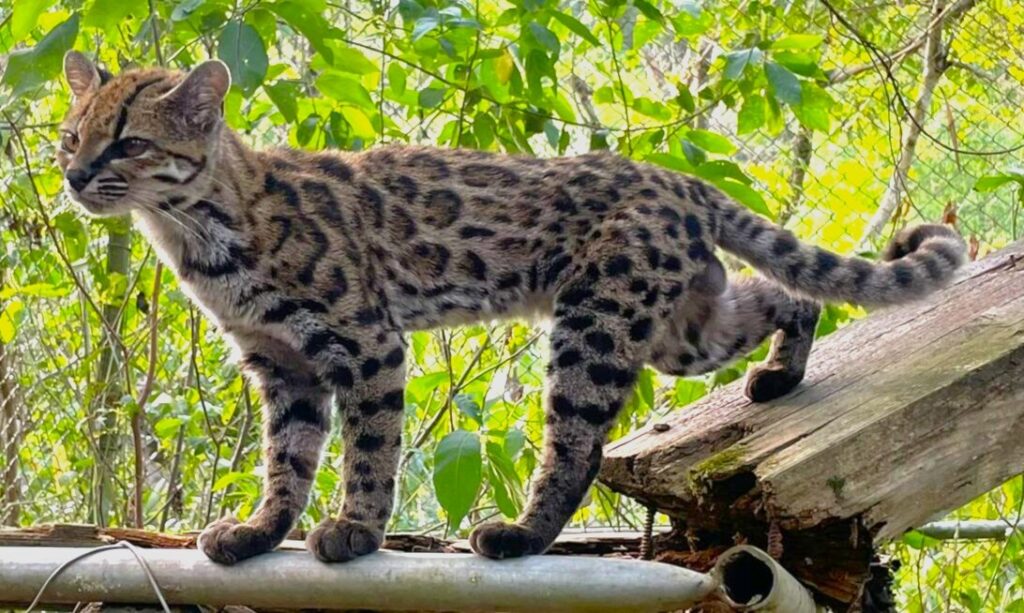
For a year, a Bolivian family cared for him just like any other kitten. Then came the suspicion: that little spotted feline wasn’t a pet, but a wild animal. After being taken to the Senda Verde shelter in the Yungas region, that “cat” turned out to be much more than just a curiosity. It is the Leopardus tilcayo, the first new living species of feline to be formally described since 1923, the year the pampas cat was classified.
The discovery, published in the journal *Current Biology* and reported by National Geographic, is the work of an international team led by biologist Paola Nogales-Ascarrunz, a National Geographic Explorer who heads the felid research program in Bolivia. It all began in 2016, when the researcher first saw the specimen at the sanctuary. Its features—small, rounded ears, a flattened muzzle, and long whiskers—did not match any known description, almost all of which were based on Brazilian cats. “This made us wonder: what kind of tiger cat do we really have in Bolivia?” the researcher said.
About 46 centimeters long and weighing just 1.4 kilograms, the tilcayo is smaller than a house cat. It has a light brown coat with dark, irregular rosettes that are larger than those of the tiger cat (Leopardus tigrinus). The name pays tribute to local communities: “tilcayo” is the word they use to refer to the animal. “It’s our way of honoring ancestral knowledge and our connection to this animal,” the biologist explained. “But it also serves as a reminder that we must protect the Yungas forests, home to many species, some of which we’re only just beginning to understand.”
The DNA of 38 felines
Genomic analyses turned a hunch into a certainty. The team sequenced the DNA of 38 felines from various South American countries, eight of which were preserved in museums. The results overturned previous beliefs: the so-called tiger cats, long considered a single species, are in fact five genetically distinct species, each with its own evolutionary history. The tilcayo lineage diverged from the others about 1.4 million years ago. It is a “cryptic species,” as co-author Jonas Lescroart of the University of Antwerp described it: impossible to distinguish with the naked eye.
Very little is still known about this feline. The remains of small rodents found in its droppings indicate its diet, while camera traps suggest it is nocturnal. How many tilcayos exist in the wild, however, remains a mystery: the only captive specimen is the male at Senda Verde, while a female, attacked by local residents, was rescued and then released.
This story also serves as a warning. The Yungas, where the Andes meet the Amazon, are among the least-studied areas of the Neotropics, yet they harbor extraordinary biodiversity that is increasingly threatened by agriculture and urban development. “These are all habitats that are rapidly disappearing,” warns Tadeu de Oliveira, an ecologist at the State University of Maranhão. The fact that a species of this size remained undiscovered until 2026 shows just how much remains to be discovered—and how quickly we risk losing it.