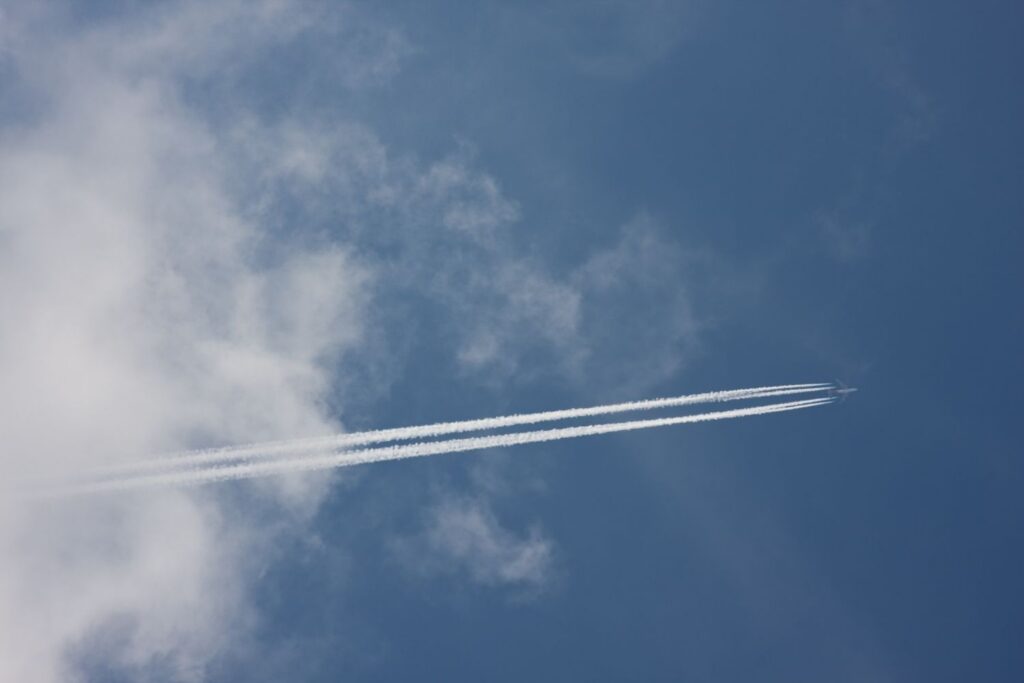
Those white trails that airplanes leave in the sky certainly do not hide any global conspiracy against humanity, but it is true that they are by no means harmless. When the hot air from a jet’s exhaust mixes with moisture and soot at high altitudes, it forms a trail of ice particles that traps heat in the atmosphere. Scientists have long warned of this risk, and now the United Kingdom has launched Operation Blue Skies to test whether it’s possible to reduce this effect with minor adjustments to flight paths.
Over the next two winters, British air traffic controllers will ask hundreds of pilots flying over the eastern portion of the Atlantic Ocean to adjust their flight paths, directing them to altitudes where persistent contrails are less likely to form. The project costs 5 million pounds (about 5.9 million euros), of which 2.65 million comes from public funds, with Google contributing 1.4 million toward research and technology. It is the largest experiment ever attempted in this field.
Contrail Effect
Experts call it the “contrail effect,” from the English term “contrail,” short for “condensation trail.” According to one study, this phenomenon accounts for up to 35% of the global warming caused by aviation. The result, according to Contrails.org, a nonprofit organization involved in the project, is that contrails contribute 1 to 2% of all human-caused global warming.
The test will take place in the Shanwick airspace, a busy corridor west of Ireland in the North Atlantic, which alone accounts for about 5% of global warming caused by contrails. Using a combination of weather data and Google’s artificial intelligence analysis, air traffic controllers will ask pilots to slightly adjust their altitudes. About 10,000 flights are expected to fly through the designated airspace during the two scheduled test periods, which will last a total of 30 months and will assess the climate impact of reducing contrails and the feasibility of extending these navigation adjustments on a larger scale.
Even a very small adjustment to an airplane’s altitude can have a significant impact on reducing the contrails it produces, explains Edward Gryspeerdt, an associate professor of atmospheric physics at Imperial College London. He is part of a team of scientists from that institution and the University of Cambridge who will analyze satellite images to assess the effect of the test.
Gryspeerdt explains that contrails form when an airplane flies through a moist layer of the atmosphere—a narrow band of air that is often only three hundred meters thick. “That’s where there’s enough water to form a cloud but a shortage of particles for that water to freeze onto. When the airplane arrives and provides this initial burst of ice crystals, those crystals draw water from the atmosphere and grow into these persistent clouds.”
Avoid contrails
Clouds can last for minutes, but sometimes they persist for hours, mixing with other contrails and amplifying the greenhouse effect. “From our perspective, avoiding contrails is the most promising short-term opportunity for climate action,” says Marc Shapiro, executive director of Contrails.org. “Through these small, targeted changes to flight paths when conditions are right, we should be able to eliminate a significant portion of aviation’s climate impact.”
If the program proves effective and is expanded globally, Shapiro estimates that navigation adjustments could theoretically reduce global ship wakes by 70 percent. “We see this as feasible within the next five years. We want to encourage more experiments like this globally so we can figure out how to do it as quickly as possible.”
The test is based on previous research by Google, Breakthrough Energy, and American Airlines. The aviation industry has identified reducing contrails as a low-cost and relatively easy way to reduce the impact of flying on global temperatures. In 2025, Google stated that a previous effort with American Airlines to use contrail forecasts had reduced contrail formation by more than 60%.
Contraindications
But the strategy has its drawbacks. Even minor adjustments to an aircraft’s flight path can increase the amount of jet fuel it burns. Flying at lower altitudes, where the atmosphere is less dense, also requires additional fuel.
Gryspeerdt explains that previous studies have found that the overall benefits of reducing contrails still outweigh the impact of burning extra fuel, but he notes that the test will examine this issue. “Weather, aviation, and clouds are complex problems and complex systems. As we gain a better understanding of how to route planes around these regions, I think we can at least reduce the warming caused by contrails, if not eliminate them entirely.”