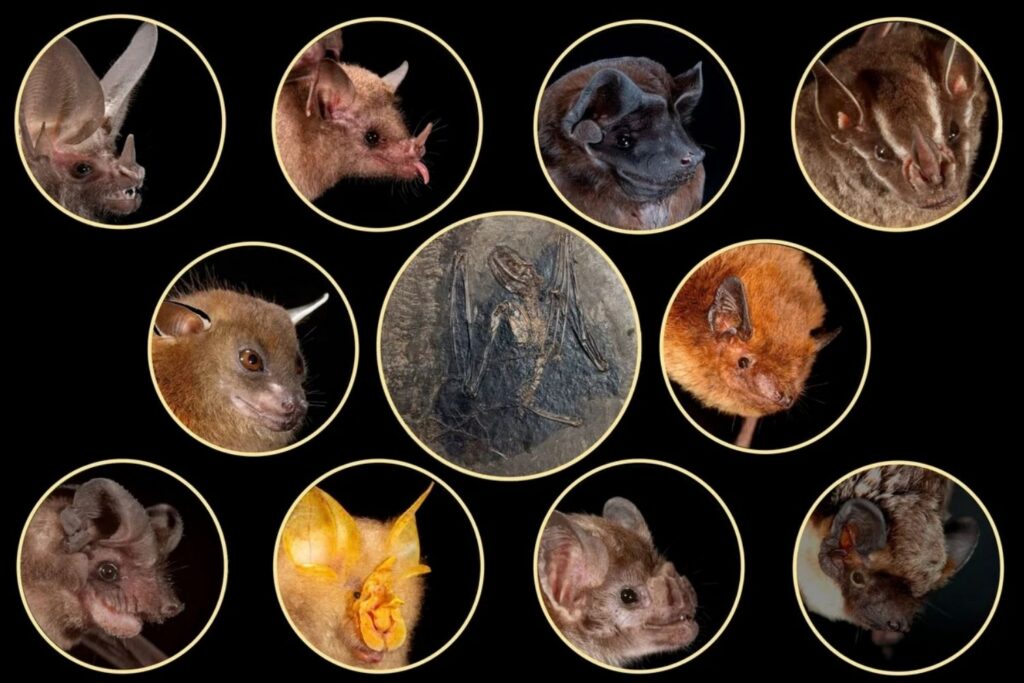
Where and when the first bats appeared has been a subject of debate for decades. The oldest known fossils, dating back to the Eocene, already show a fully formed animal with the anatomical structures necessary for flight and echolocation, and offer no insight into the stages that preceded it. Now, a new reconstruction, based on a combination of genetic and paleontological data, places the origin of the group in Europe, about 65 million years ago, during the Paleocene.
The study, titled“Reference Genomes and Fossils Revise Bat Family Phylogeny and Biogeography,” appeared in *Nature* on September 23, 2026.
It was led by Bat1K, an international consortium established with the goal of producing high-quality reference genome data for all living bat species. A total of 137 researchers from 64 countries worked on the project; Among the institutions involved were the University of St. Andrews in Scotland, where consortium director Sonja Vernes is based; the Senckenberg Research Institute in Frankfurt, with Michael Hiller among the senior authors; and the Museum für Naturkunde in Berlin.
This study represents the first phase of the project. The team analyzed the genomes—assembled at the chromosomal level—of 103 species, 42 of which were sequenced specifically for this study, in order to represent all 21 currently recognized families of bats. This data was supplemented by a set of 699 morphological characters relating to 65 species, including 44 fossils dating from before the Quaternary. Statistical models that account for the age of the specimens made it possible to place each evolutionary lineage in time and space.
A European origin
According to the biogeographic model, the common ancestor of all bats lived in Europe; the probability that the origin is European—a statistical estimate derived from the model—is 99.2%. From there, the descendants are thought to have spread primarily toward Africa, forming a Europe-Africa axis from which subsequent expansions toward Asia, the Americas, and Australia originated.
The result goes beyond previous hypotheses, which pointed to North America, Africa, or Asia. The question remained unresolved for a long time for an intrinsic reason as well: bats are the only mammals capable of active flight and can travel great distances, thereby erasing the geographical traces of their origins over time. The main evolutionary lineages are thought to have diverged within a short time frame, around 56 million years ago, coinciding with the peak temperature of the transition from the Paleocene to the Eocene, a period of intense and rapid global warming.
Flight and echolocation
The reconstruction also covers the two traits that most distinguish bats. The first is active flight, which, according to the study, was already present in the early stages of the group’s history. The second is laryngeal echolocation—that is, the ability to emit sounds using the larynx and interpret their echoes to navigate in the dark and locate prey.
An important clue comes from Vielasia, a fossil bat that analysis places in the oldest branch of primitive bats. This positioning indicates that laryngeal echolocation predates the diversification of modern bats. Flight and echolocation would therefore have both emerged very early on, within the same evolutionary lineage, rather than at separate times.
A Revised Phylogenetic Tree
The research also addresses a well-known issue in bat genetics: individual genes can tell different evolutionary stories, and the results depend on which portion of DNA is considered. To get around this difficulty, the team compared neutral regions of the genome—that is, regions less subject to natural selection—with whole genomes and other molecular data, and then verified the results using fossil morphology.
This has resulted in a revision of the phylogenetic tree of bats. Among the findings is the new classification of the Myzopodidae, a family endemic to Madagascar, which is identified as the most ancient branch within the Vespertilionoidea.
With more than 1,500 species, bats account for more than one-fifth of all living mammals. The study now provides a framework for investigating other characteristics of the group as well, such as resistance to various infections and their remarkable longevity relative to body size.