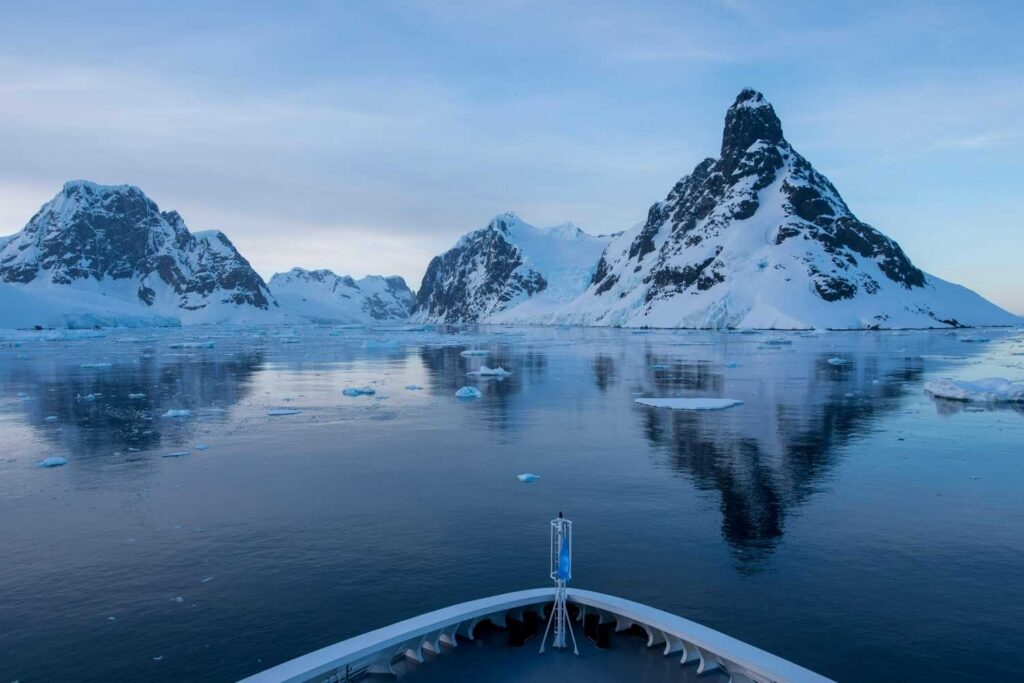
On September 14, the ice floating around Antarctica reached its maximum extent for the Southern Hemisphere winter: 17.59 million square kilometers. It is called sea ice and consists of frozen seawater, which is different from glaciers, which form on land. This preliminary figure comes from the National Snow and Ice Data Center (NSIDC), the U.S. agency that has been collecting satellite measurements since 1979. According to The Guardian , it is about one million square kilometers below average—an area twice the size of Spain.
The sea ice follows an annual cycle: in the summer, it falls below 2 million square kilometers; in the winter, it exceeds 17 million. To understand how it’s faring, we compare the September maximums; the four lowest values in the entire satellite record are the most recent four. “A clear indicator of a change in the system,” Ariaan Purich, an Antarctic Ocean expert at Monash University in Melbourne, explained to the British newspaper. Carbon Brief reports monthly data from Clare Eayrs of the Korea Polar Research Institute: the five lowest July extent readings are all from 2022 onward, and the four lowest August readings are from 2023 onward. In June, temperatures on the Antarctic Peninsula were 20 degrees above normal.
There are various perspectives on why this is happening, each taking into account the various factors contributing to the climate crisis. Purich points to winds associated with El Niño, the periodic warming of the tropical Pacific. Lettie Roach, of the Alfred Wegener Institute, tells Carbon Brief that “several years of observations” are needed to determine whether the change is lasting. As for the present, however, Purich is unequivocal:“This isn’t a future problem. It’s a current problem.”
What Is Lost When There Is No Ice
Sea ice serves at least three functions. It reflects sunlight, while dark water absorbs it and warms up. It protects ice shelves—floating tongues attached to the coast that slow the advance of inland glaciers: if waves weaken them, that mass can slide into the sea and cause sea levels to rise by many meters. Finally, it provides a habitat for algae and krill—small crustaceans at the base of the food chain—and serves as a breeding ground for emperor penguins to reproduce and raise their young.
Will Hobbs, of the University of Tasmania, notes that since its peak in September, the sea ice has been shrinking “faster than usual.” Another summer with little snow, he adds, would make the situation “very concerning.”
Less Data Right Now
The ability to track the phenomenon is also diminishing. In March, NOAA, the U.S. National Oceanic and Atmospheric Administration, stopped publishing a dataset on atmospheric pressure that PIOMAS—the system that estimates Arctic sea ice thickness—relies on. Updates have been suspended. The PIOMAS website mentions “considerable effort and time” required to find alternative data and is unsure whether funding will be sufficient. Hobbs sums it up: the system “is changing faster than we can understand it.”