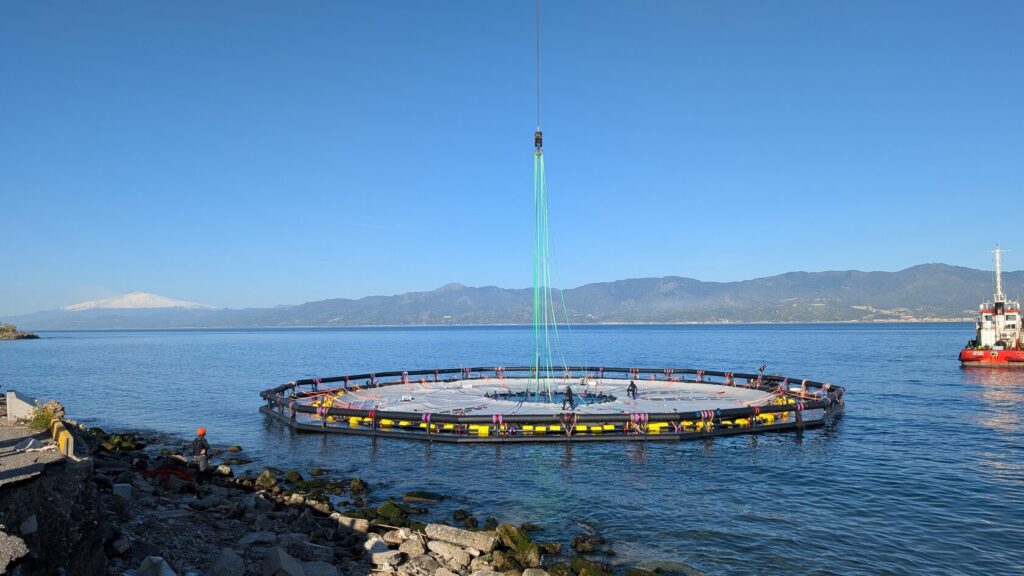
In the Strait of Messina, off the coast of Reggio Calabria, a system has gone into operation that could help change the way we store renewable energy. It consists of a large floating tank, fifty meters in diameter, that uses gravity and the depth of the sea to store electricity. The Milan-based startup Sizable Energy installed its prototype at the Natural Ocean Engineering Laboratory of the Università Mediterranea, completing a logistical operation that required a 350-metric-ton crane with a reach of about fifty meters.
Eleven metric tons of the structure now float on the surface, connected to a tank resting on the seafloor. Between the two, saturated seawater circulates (that is, seawater with a salt concentration close to saturation, and therefore denser and heavier than normal water) circulates between the two, rising and falling through turbines, converting excess energy from the grid into fluid motion and then reconverting it into electricity when needed.
A continuous source
The principle is that of pumped-storage hydroelectricity, which we are familiar with from dams in mountain reservoirs. When there is excess energy on the grid, you use it to pump water uphill into a reservoir. When there is a shortage, you let the water flow down through the turbines to generate electricity again. The solution proposed by Sizable Energy moves the entire process out to the open sea. Brine, which is 20% denser than regular water, is pumped from the seafloor to a floating reservoir when there is excess energy. When the grid needs it, gravity does its job: the fluid flows down, drives the reversible turbines, and generates electricity. The system can operate at depths of more than 500 meters, taking advantage of the vertical space available in the ocean.
The idea addresses an increasingly urgent problem. Renewable energy sources are intermittent. The wind blows when it wants to, the sun shines during the day, while energy demand follows its own patterns. During peak production periods, if you have nowhere to store the excess electricity, you either waste it or have to shut down the plants. During peak demand periods, if there’s no wind or sun, you have to fire up gas-fired power plants. The result is that the more renewable energy you install, the more you need storage systems capable of balancing production and consumption. And this is where the problems begin, because the available solutions all have obvious limitations.
Lithium-ion batteries—what we call BESS—are fast and flexible and are relatively easy to install. But they are expensive, have a limited lifespan, require critical raw materials mined in only a few countries, and are not designed to store energy for days or weeks. Traditional pumped-storage hydroelectric plants, on the other hand, have enormous capacity and last for decades, but they require favorable geographical conditions, heavy investment, and long construction times. We have several of these in Italy, but we cannot build many more. Ground-based gravity systems, using concrete blocks lifted by cranes, are still in the experimental phase. Green hydrogen could serve as long-term storage, but energy losses in the production-storage-conversion cycle are still too high to make it competitive. Compressed air, stored in underground caverns, is an interesting option but is geographically constrained.
It can be installed anywhere
Marine pumping falls somewhere in between. It offers the capacity and durability of traditional hydroelectric pumping but does not require mountains. It can be installed anywhere there is a coastline with deep waters—a condition found in vast areas of the Mediterranean, the Atlantic, and the Pacific. The materials are simple: steel, concrete, and reversible turbines, based on existing, proven technologies. Its modular design allows for scaling up power and capacity by adding reservoirs. According to the project, the visual impact would also be minimal. From an environmental standpoint, the system operates in a closed-loop circuit using brine, without consuming freshwater or discharging anything into the sea. The system is designed to minimize noise and allow for coexistence with marine life.
Sizable Energy has already passed the tests conducted at the Dutch MARIN research center, which were designed to verify the system’s reliability even in rough sea conditions. Now the testing is moving to the open sea, in the natural laboratory of the Strait of Messina. Here, the prototype will have to demonstrate that assembly and installation are feasible, that the floating components can withstand marine conditions, and that the system is capable of operating safely. If all goes well, the next step will be a demonstration plant with a capacity of several megawatt-hours, also in Italy, which will serve as the starting point for commercial projects in 2026 in collaboration with local partners and energy suppliers.
The Founders
The company was founded by engineers from the energy sector with the stated goal of offering long-term energy storage at competitive prices. Manuele Aufiero, CEO and co-founder, explained that without economically viable storage systems, the power grid risks facing difficulties, regardless of the energy mix. “The depth of the ocean,” commented Bruce Leak of Playground Global, an American fund that led the $8 million funding round closed in October 2025, “the depth of the ocean is a virtually unlimited resource that Sizable Energy is harnessing to offer long-duration storage at a cost that, according to the investor, could be lower than that of batteries.”
The project also involved Geodis, a global logistics provider that handled the launch, transport, and installation operations on behalf of Sizable Energy. The team performed engineering calculations, prepared technical documentation, determined crane positioning, designed the lifting operations, and specified the systems needed to secure the structure. It provided on-site technical assistance and supervision throughout all phases, ensuring that this complex operation complied with site constraints and environmental requirements.
The Natural Ocean Engineering Laboratory is one of Italy’s leading offshore sites for testing innovative technologies in the field of marine energy. Its location in the Strait of Messina offers conditions particularly well-suited for experimentation, thanks to the deep seabed just a short distance from the coast and the strong ocean currents. The presence of nearby port and university facilities also facilitates operations.
The Commercial Scale
It remains to be seen whether the model will work on a commercial scale. Sizable Energy claims its costs are competitive even compared to the most optimistic projections for lithium-ion battery cost reductions. The modular design would allow the capacity to be tailored to the specific needs of each site. The ability to utilize existing shipbuilding facilities and maritime infrastructure would reduce installation time and costs. But there is a considerable gap—and not just in terms of distance across the sea—between an 11-metric-ton prototype and a plant capable of generating hundreds of megawatt-hours. Investments, permits, industrial partnerships, and engagement with affected communities are needed. And it must be demonstrated that the technology is durable over time, that maintenance is manageable, and that cost estimates are realistic.