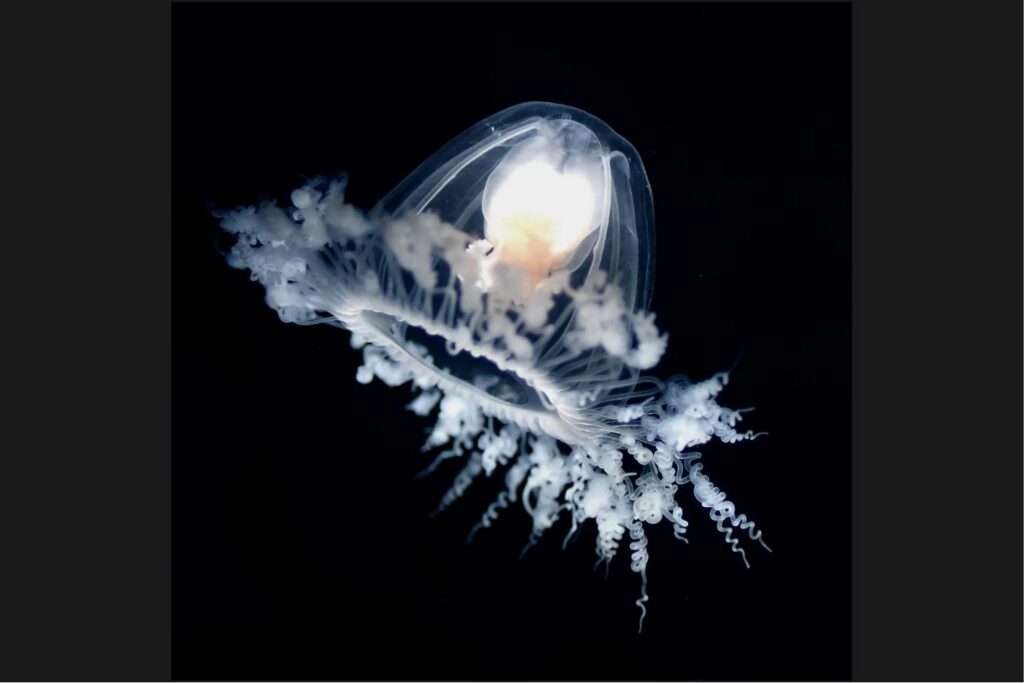
A jellyfish measuring just a few millimeters—also found in the Mediterranean—is capable of undergoing a biological process that is generally irreversible in other animals: reverting to a youthful state after reaching adulthood. It is called Turritopsis dohrnii , and its extraordinary ability to reverse its life cycle is providing scientists with new tools to study aging and tissue regeneration.
This phenomenon occurs primarily when the animal faces harsh environmental conditions. Fasting, injuries, and sudden changes in temperature or salinity can trigger a radical transformation: the jellyfish loses its adult form and regresses into a mass of cells that attaches itself to the substrate, forming a new polyp. From this juvenile colony, new, genetically identical jellyfish can subsequently be generated through budding.
How Rejuvenation Works
The phenomenon was first observed in 1992 at the Rapallo Marine Laboratory by Italian zoologists Ferdinando Boero, Stefano Piraino, and their colleagues. Since then, Turritopsis dohrnii has become a fundamental model organism for developmental biology.
At the heart of this process is transdifferentiation—that is, the ability of certain already-specialized cells (such as muscle or skin cells) to lose their identity and reprogram themselves to form completely different tissues.
“There is no single ‘youth switch,’” explains Maria Pia Miglietta, a marine biologist and professor at Texas A&M University, in an interview with Green&Blue. Rejuvenation, in fact, requires a complex cellular and molecular reorganization.
The secret lies in the genome
A study by the University of Oviedo, published in PNAS in 2022, shed light on the jellyfish’s genetic map. The researchers sequenced the genome of Turritopsis dohrnii and compared it with that of the closely related species Turritopsis rubra, which is unable to reverse its life cycle after reaching maturity.
The comparison revealed that the “immortal” jellyfish possesses twice as many copies of genes associated with DNA repair and maintenance, with hyperactive mechanisms that correct genetic damage accumulated over time. Furthermore, it exhibits a greater ability to preserve telomeres —the protective structures of chromosomes that tend to shorten with age in humans—and a network of genes that is particularly efficient at controlling oxidative stress and reactivating cellular pluripotency, that is, the ability of adult cells to revert to a stem cell state and transform into any new tissue.
Why is it called the “immortal jellyfish”?
The nickname can be misleading. Under favorable laboratory conditions, Turritopsis dohrnii is able to repeat the cycle reversal multiple times, but scientists do not know of an upper limit on the number of cycles that applies to all individuals.
Above all, the ability to revert to a juvenile stage does not equate to invulnerability. In nature, jellyfish can be preyed upon by other organisms, succumb to pathogens, or fail to complete cellular reorganization during times of stress.
What It Can Teach Us About Human Health
The scientific community is interested in regenerative medicine and oncology. Understanding how jellyfish manage to alter cellular identity without losing control of growth could help clarify why human tissues lose their ability to regenerate and how to safely reactivate that ability.
However, applications in humans are still a long way off. Reprogramming human cells carries significant risks: imperfect control of the process could trigger uncontrolled tumor proliferation.
“We are still a long way from directly applying these mechanisms to rejuvenate the human body,”warns Miglietta. The priority remains deciphering the genetic mechanisms underlying this plasticity to understand how to repair organs and tissues damaged by age-related diseases.