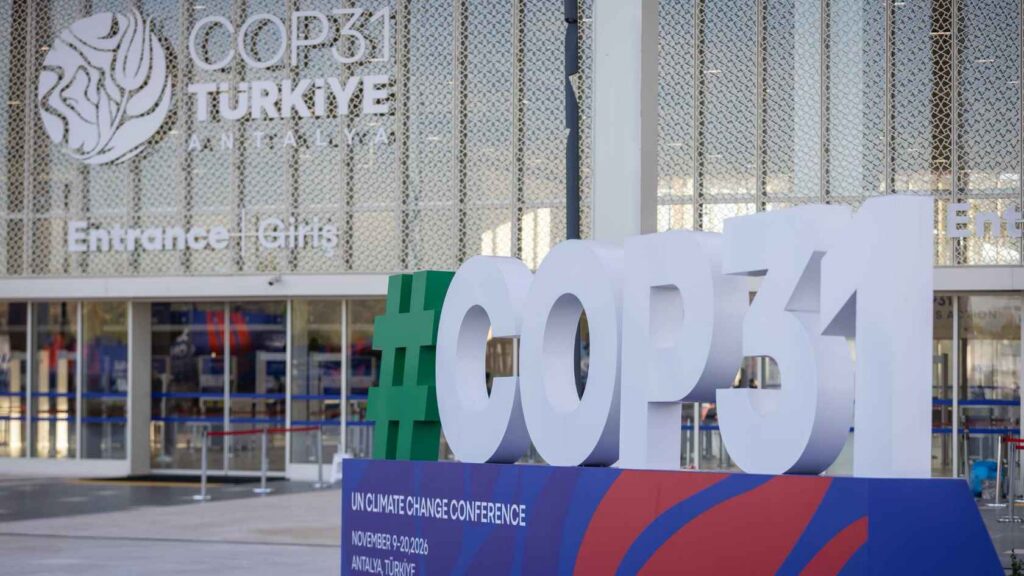
After its first week of proceedings, COP31 in Antalya is proceeding amid the usual divisions and a desperate need for resources, and is essentially hinging on a formula known as a “cover decision,” which could resolve the situation without upsetting anyone too much, by making political statements in favor of the transition and thereby maintaining, in the eyes of the public, the “momentum” of the commitment—but without these statements being binding in any way, even if they are approved by consensus by the COP assembly.
Since Copenhagen, commitments—especially mitigation commitments, the so-called NDCs—have been decided by individual countries and only later become binding (but without any real penalties, making them little more than a token commitment). Therefore, there is no real risk for oil, gas, and coal-producing countries. But Saudi Arabia and its Gulf allies, Russia, and other fossil fuel producers do not trust the process and would like to avoid even cautious statements of principle, such as the one on an “orderly, just, and equitable” transition away from fossil fuels that emerged from COP28. If there is to be a cover decision, it will only happen with their approval. We can therefore imagine what the language will look like. But this is the situation given the current political landscape and the UNFCCC’s rules, which are bound by consensus.
What Is a Cover Decision?
The “cover decision” is a formal decision of the COP. It is an “umbrella” decision that encapsulates the summit’s overarching political messages: ambition, finance, energy transition, and so on. It complements technical decisions on specific issues (adaptation, carbon markets, agriculture, loss and damage, etc.). It is not provided for in the UNFCCC texts, but has become standard practice. Recent examples include the Glasgow Climate Pact (COP26), the Sharm el-Sheikh Implementation Plan (COP27), and theUAE Consensus (COP28, the one on the “transition away from fossil fuels”).
The co-chairs prepared the drafts after consulting with the negotiating groups, and the“Summary of Reflections”published by Australia serves precisely this purpose: to compile what countries would like to see included. But the draft is only a proposal. Countries amend it, challenge it, and renegotiate it, often right up until the last minute. It is adopted by consensus in the final plenary session. There is no vote: it is sufficient that no delegation formally objects when the chair brings down the gavel. This is why the final texts are compromises, with deliberately flexible wording. Once adopted, it is an official decision of the Conference of the Parties, but it is not legally binding like a treaty: it carries political weight and can guide subsequent negotiations and national policies.
If consensus is not reached, the cover decision is simply not adopted, and the COP concludes with only the technical decisions. Two classic examples of failure to adopt a decision: Copenhagen in 2009, when Bolivia, Cuba, Venezuela, Sudan, and Nicaragua opposed it, and thus no consensus was reached. The COP merely “took note” of the Copenhagen Accord, which was not adopted as an official decision. Then there was The Hague, COP6 (2000): negotiations on the implementation rules for the Kyoto Protocol collapsed, mainly due to the clash between the United States and the EU over the role of forests and carbon “sinks.” The conference was suspended without an agreement and resumed in Bonn in July 2001, where an agreement was reached. This was not a “cover decision” in the strict sense, but rather a comprehensive political package that was not adopted within the scheduled timeframe.
Then there are the watered-down agreements. Madrid, COP25 (2019): the synthesis decision (Chile Madrid Time for Action) was adopted, but it was very weak, and the rules on Article 6 (carbon markets) were postponed. Belém, COP30 (2025): the final political decision was adopted, but without a roadmap on fossil fuels, which was one of the most contentious issues. The closing decision is the“Global Mutirão”(from a Brazilian term meaning “collective effort”). The summit concluded on Saturday, November 22, 2025, after all-night negotiations, resolving all points of disagreement and thus resulting in a very weak outcome. Unlike in Copenhagen, the outcome document at COP30 was approved by consensus. However, it is a classic case of “watered-down” adoption.
What do the states want?
On Thursday night, the Chair issued a summary note compiling the various positions expressed by the Parties during the consultations held over the past few days on the cover decision, without necessarily reflecting points of consensus or the relative weight of the different positions. The Parties had until Saturday to submit their comments and contributions, based on which the Presidency will prepare a first draft of the cover decision at the beginning of the final week.
“The document,” notes the climate think tank Ecco, – reflects the deep divisions that emerged in the early days of consultations, but also contains some important signals. Among these are the need to address the exceeding of the 1.5-degree threshold by limiting its duration and intensity; the reference to implementing the commitments from the first Global Stocktake on the transition away from fossil fuels; the reference to the fossil fuel and forest roadmaps launched by the COP30 Presidency; and the mention of the advisory opinion of the International Court of Justice on climate change. There are also references to reducing methane emissions and the goal of increasing the share of electricity in final energy consumption to 35% globally by 2035, accompanied by the accelerated deployment of renewables, energy efficiency, and investments in grids and storage, as well as adequate financing. However, some problematic phrasing remains, including the call for technology neutrality, the need to avoid setting specific targets for sectors or energy sources, and the reference to paragraph 29 of the Global Stocktake on transition fuels, which risks paving the way for electricity generation from natural gas.”
“On the financial front,” the Italian think tank continues, “the report places a strong emphasis on public finance, acknowledges the failure to meet existing commitments, and highlights the need to implement the Baku (NCQG), to triple funding for adaptation by 2035, to strengthen the use of non-debt-creating financial instruments, to recapitalize multilateral funds, and to eliminate inefficient fossil fuel subsidies. It also mentions the role of trade and expresses concern about unilateral measures. However, significant differences remain regarding the level of ambition in the decision: some countries insist on the need to avoid imposing top-down targets and to refrain from referring to specific sectors or energy sources, while others are calling for clearer political signals to accelerate the implementation of existing climate commitments.”
In Search of Money
Every COP places the issue of funding at the center of its agenda, and the key message from the first week was that climate finance must be disbursed more quickly, under more accessible terms, and without increasing debt vulnerability. How to achieve this is the subject of extensive debate. The COP30 Presidency has published the report “Implementing the Baku to Belém Roadmap to 1.3T,” which shows that mobilizing $1.3 trillion per year in climate finance for developing countries by 2035 is an achievable goal, provided that governments, financial institutions, and investors take the necessary steps.
Friday’s discussion focused on the financial pathways and policy actions needed to turn this global ambition into a concrete reality. Speaking at the seventh biennial high-level ministerial dialogue on climate finance, the Executive Secretary of the United Nations Framework Convention on Climate Change, Simon Stiell, said that “the Roadmap from Baku to Belém represents a path to achieving the $300 billion and $1.3 trillion targets set at COP29 and must become a reality.” Climate finance, he added, “must help countries break free from a vicious cycle of debt, disasters, and devastating capital costs.” In theory, Stiell is absolutely right; the challenge lies in finding the tools to make this possible and, above all, acceptable to those who hold the money.
Hypocrisy and the Market
The British monthly *New Scientist* has published a scathing article criticizing political negotiators, convinced that the solution will come from the business world, which is already convinced of the merits of the energy transition. In its view, this transition is desirable from an environmental standpoint but, above all, economically advantageous. “At the COP31 summit in Turkey,” writes New Scientist, “the atmosphere is steeped in hypocrisy. British Prime Minister Andy Burnham has stated his intention to demonstrate the United Kingdom’s leadership on climate action. Meanwhile, however, his government has just given the green light to the Jackdaw gas field in the North Sea, which will emit up to 36 million metric tons of carbon dioxide without significantly reducing energy prices, and is considering approving the Rosebank oil field, in addition to relaxing regulations on electric vehicles.”
The countries jointly hosting the summit, Turkey and Australia, are promoting a clean energy revolution, but this week Turkey announced two new oil fields that would help increase production by 30 percent, while promising to double natural gas production. Australia has recently approved fossil fuel projects, including the expansion of a coal mine (dubbed a “climate bomb”) that will emit enough carbon to kill another 15 million coral colonies on the Great Barrier Reef during every bleaching event.
“But,” New Scientist notes, “there is some good news. The Global Carbon Budget has just announced that emissions from fossil fuels are expected to decline slightly in 2026. Of course, the 0.4% decline would not have occurred without the oil crisis caused by the war in Iran. However, the growth of low-cost solar power, wind power, and electric vehicles has offset emissions that would have been higher than during the peak of oil prices.”
Therefore, “if clean technologies continue to gain momentum, global CO₂ emissions could peak and then decline steadily within a few years,” according to the Global Carbon Budget report. “This means that it is the economy—not politics—that is driving the transition to clean energy, despite the lack of leadership demonstrated at COP31.” The revolution underway cannot be stopped, even if leaders incapable of climate leadership do their worst to ensure that promises remain just that and the COPs become nothing more than a colossal monument to “I’d like to, but I can’t.”