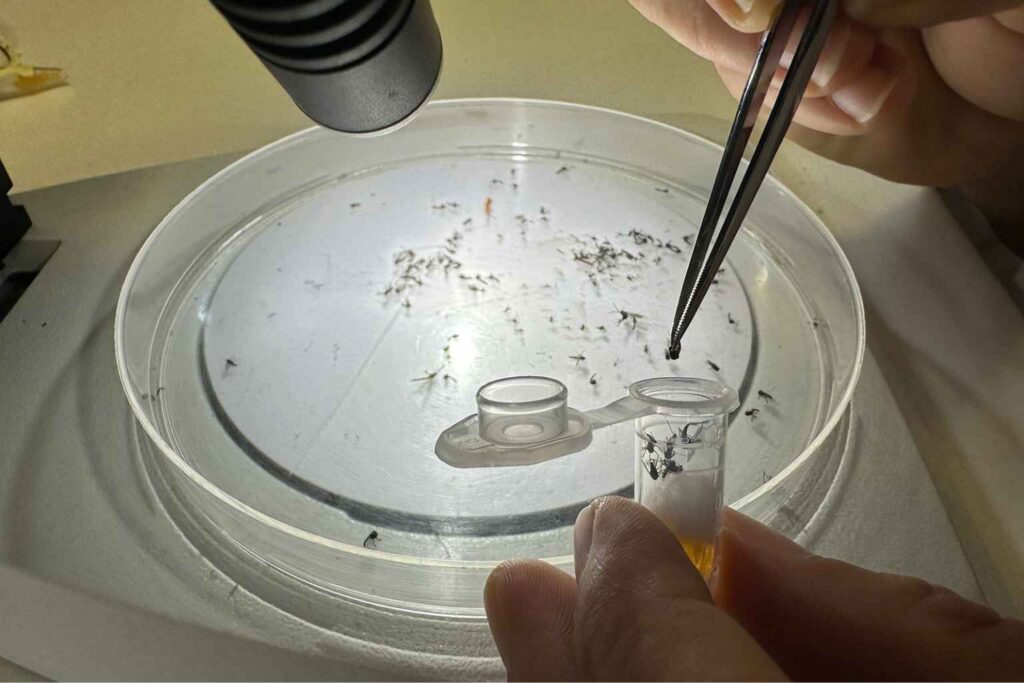
A tiger mosquito that doesn’t bite, doesn’t transmit diseases, and actually works against its own species. This is the core of the containment strategy developed by ENEA and implemented for the first time in Europe on a large scale and in an urban setting: in Barcelona, over 1.5 million males were released, capable of reducing the fertility of the wild females with which they mate. In Spain, the plan was carried out by Debug—Google’s mosquito control project—and the pest control company Rentokil, in collaboration with the Barcelona Public Health Agency.
How it works
The method is called the Insect Incompatibility Technique (IIT) and utilizes Wolbachia, a bacterium that is widespread in nature and harmless to humans. Wolbachia lives inside the cells of many insects and is transmitted from mother to offspring. Even wild tiger mosquitoes harbor certain strains of it. Enea was the first in the world to develop a line of tiger mosquitoes in which these strains were removed and replaced with one derived from the common mosquito, Culex pipiens. When these males mate with wild females, which harbor a different strain, the eggs are sterile: no new mosquitoes are born, and, release after release, the population declines. With an added benefit: less use of insecticides.
The technique is also highly selective. The males do not sting, and once released, they seek only females of their own species, with no impact on other insects. Furthermore, no molecules or organisms that are not already present in nature are introduced into the environment.
The Test at Casaccia
Before being implemented in Spain, the strategy was tested in Italy. Between 2025 and 2026, Enea and Debug conducted a two-year trial at the Enea Casaccia Research Center, just outside Rome, in collaboration with Sapienza University. Between late July and late October 2025, approximately 1.6 million males were released across the center’s 53 hectares. The result: an 88% reduction in the number of fertile eggs destined to overwinter—that is, those from which the infestation would have resumed the following spring.
The division of labor was clear-cut. ENEA developed the mosquito strain and the IIT platform. Google, through Debug, expanded the strain, selected the males, and handled transportation from Miami. Sapienza University validated the technique and monitored the control areas. The 2026 trial is still underway and will conclude in November, with releases occurring earlier than in the previous year and at higher doses.
Not just bites
The stakes go beyond the mere annoyance of bites. The tiger mosquito, an invasive species that arrived in Italy from Asia, is a vector for dengue, chikungunya, and Zika. These are diseases once associated with tropical and subtropical climates, which global warming is making increasingly common even in our latitudes. In 2026, outbreaks were reported in Tuscany, Lombardy, and Puglia, while there have been hundreds of cases across Europe in the past year.
The transition from a fenced-off research center to a metropolis like Barcelona marks a decisive leap in scale. It demonstrates that the method can work even where the tiger mosquito is hardest to control—in courtyards, storm drains, and plant saucers. And it paves the way for a viable alternative to chemical treatments, which until now have been the primary—and often ineffective—response to the spread of this insect.