There is a patch of countryside within the walls of Vatican City. It isn’t large, but it still serves a purpose that dates back to the very origins of the Vatican Gardens: providing food for the papal residence. Today, that garden—owned by the Mater Ecclesiae Monastery— is cultivated exclusively using organic farming techniques.
The staff of the Vatican Gardens tends to the crops, while the produce is used primarily by the Benedictine nuns of the Abbey of St. Scholastica who live in the monastery. Some of the fruits and vegetables are made into jams and preserves. The surplus, however, is sent elsewhere and goes to a Vatican soup kitchen run by the Missionaries of Charity.
The vegetable garden, therefore, is not merely an ornamental feature. It is a small production system that still follows the agricultural calendar. At the end of summer, tomatoes, eggplants, green beans, zucchini, cucumbers, and bell peppers are ready. As fall arrives, the crops change: broccoli, spinach, lettuce, squash, and savoy cabbage take the place of the summer vegetables. There is also garlic, basil, and a Peruvian variety of chili pepper, while kiwi plants—requested by the Argentine nuns—have also recently been planted.
The Challenges of Water and Pests
Farming without chemicals, however, requires more work and careful management of natural balances. “Respecting nature” is the guiding principle cited by Gilberto Bianchi, the gardener who has been tending the vegetable garden and the fruit tree area since 2008.
Insects are one of the main problems. The solution is not insecticides—which are not used in the vegetable garden—but rather the use of natural predators capable of controlling harmful insect populations.
Water is also a key issue. The soil drains quickly, which is why coconut fiber is added to help retain moisture. Irrigation is carried out using a drip system, designed to deliver water directly to the plants and minimize waste. Organic farming also requires adapting to the rhythms of the seasons. It’s not about producing any crop at any time, but about adapting crops to what the season allows.
A Piece of the Gardens’ History
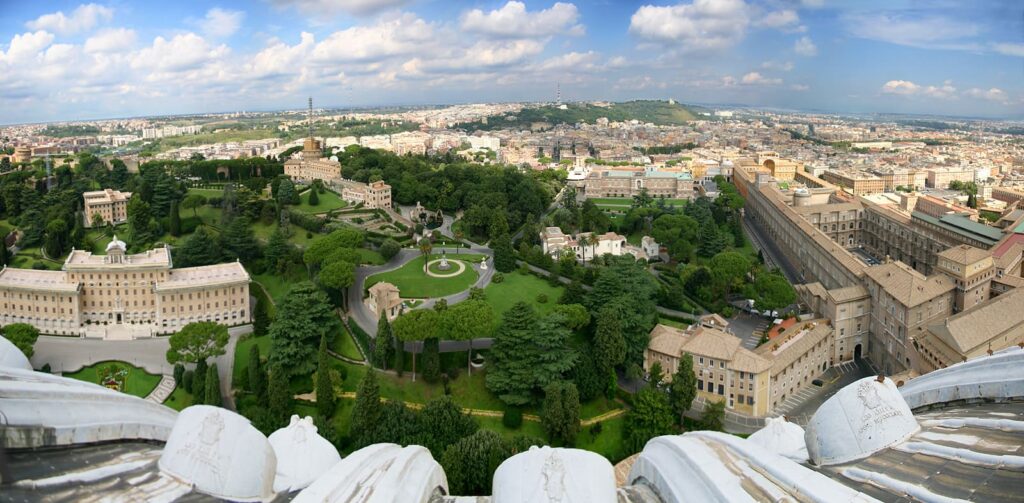
The current vegetable garden is located on the grounds of the Mater Ecclesiae Monastery, where Pope Benedict XVI lived after stepping down from the papacy and where Benedictine nuns from Victoria, Argentina, now reside. But its history is rooted in a much older story. The Vatican Gardens were established in the 13th century, when Pope Nicholas III moved the papal residence from the Lateran to the Vatican. Among the first spaces created were a lawn, a vegetable garden, and a viridarium—that is, a garden dedicated to ornamental plants.
Over the centuries, the area has evolved into a collection of diverse gardens, featuring trees, flowers, and botanical species from various locations. Today it occupies about half of the Vatican City’s territory, covering an area of approximately 57 acres, or over 23 hectares. And even the citrus grove bears traces of this past: about fifteen trees, some of which are more than 150 years old, grow alongside the cultivated area.
From a small vegetable garden to the entire Vatican
The transition to organic farming began several years ago: it was also a response to the concerns expressed by Pope Francis inhis 2015encyclical *Laudato si’ *. The stated goal extends beyond the Mater Ecclesiae garden. The project aims to gradually expand this approach to all gardens, reducing—and ultimately eliminating—the use of synthetic fertilizers and pesticides.
Thus, amid centuries-old trees and seasonal crops, the ancient garden once intended for the papal table takes on a different meaning today. It is not only the survival of an agricultural tradition within Italy’s most famous walls, but also one of the places where the Vatican is seeking to put a simple principle into practice: growing food while consuming fewer resources and letting nature do its work as much as possible.