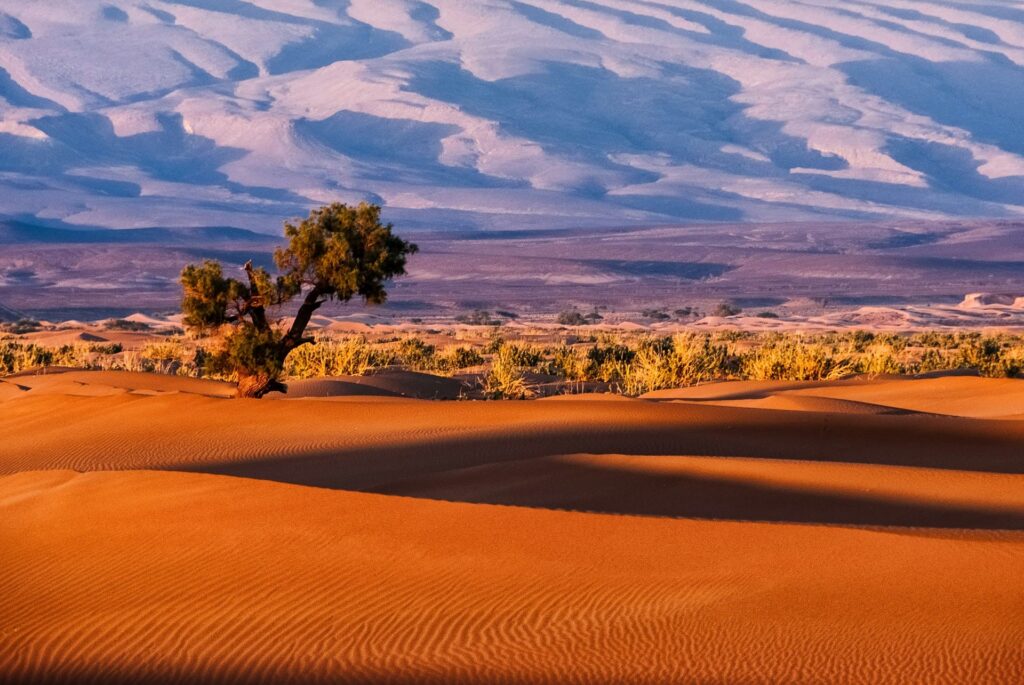
The Sahara hides evidence of a tropical sea beneath its sands. On the Abu-Tartur Plateau, between the oases of Dakhla and Kharga in the southwestern Egyptian desert, a team of paleontologists from Cairo University, in collaboration with Swiss and Colombian researchers, has unearthed fourteen fossilized teeth belonging to at least seven different species of sharks that lived approximately 76 million years ago, during the Campanian stage of the Late Cretaceous. The study, authored by Tarek Yassin, Jorge D. Carrillo-Briceño, René Kindlimann, Alhussein Ibrahim, and Mohamed K. AbdelGawad, was published in the journal *Cretaceous Research*.
A Vanished Ocean
The discovery confirms a fact already known to geologists but difficult to imagine when looking at the dunes: during the Late Cretaceous, sea levels were much higher than they are today, due to a warmer planet without significant polar ice caps. The expansion of the Tethys, the ancient ocean that separated the northern continents from the southern ones, submerged much of northeastern Africa at that time. The Duwi Formation—the geological layer from which the fossils originate—was deposited precisely during that period, when the present-day desert was a shallow marine environment rich in nutrients.
Five species never before seen in Egypt
The first study in 2025 had identified the remains of two shark species at the site: Scapanorhynchus rapax, an ancestor of the modern long-snouted goblin shark, and Cretoxyrhina mantelli, a large predator comparable in size to today’s great white sharks. The more extensive excavation revealed five additional shark species previously unknown in this area: these include Cretalamna, Scapanorhynchus, and Squalicorax—genera related to modern sharks but belonging to species different from those already known. None of these five had ever been reported before at Abu-Tartur, and one of them—a second type of Scapanorhynchus—may represent the first fossil record of its kind on the entire African continent.
These are not complete skeletons: the cartilage that sharks are made of rarely fossilizes, and in most cases, only the teeth remain. Nevertheless, it is a useful collection for reconstructing feeding habits and relationships between species: the study notes that the recovered tooth shapes—some long and pointed, others serrated, and still others curved—indicate different diets. The authors conclude that the sharks of the Duwi did not compete directly for the same prey but occupied distinct ecological niches within the same ecosystem.
The Role of Upwelling
According to the researchers, the species richness found in a relatively confined area can be explained by the phenomenon of upwelling: the rise of cold, nutrient-rich deep waters that, upon reaching the surface, trigger a food chain capable of sustaining large populations of predators. Similar phenomena, and phosphate deposits comparable to those at Abu-Tartur, have already been documented in Morocco and Senegal, confirming that Cretaceous North Africa was, overall, one of the regions with the greatest shark biodiversity on the planet.
The authors note that additional specimens and taxonomic revisions will be needed to confirm the identification of certain species with certainty, but the record from Abu-Tartur remains, for now, the most extensive ever documented in Egypt for this group of marine predators.