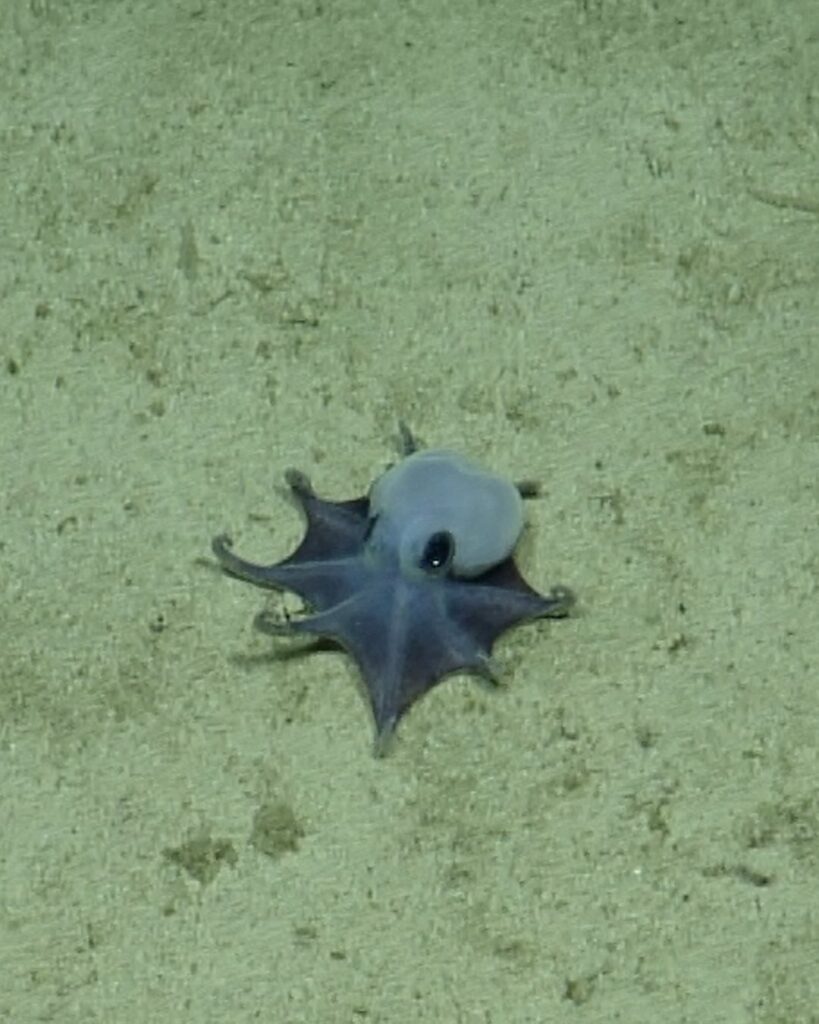
It was July 2015 when the submarine robot Hercules, 1,773 meters below the surface of the Pacific, framed something unusual on the seafloor near Darwin Island in the Galápagos. Audio from the film recorded the spontaneous reaction of scientists aboard the E/V research vessel Nautilus: “It’s tiny!” “It’s blue!”
Eleven years later, that moment became official science. On May 25, 2026, the journal Zootaxa published the formal description of Microeledonegalapagensis sp. nov., a new species of octopus detected in the depths of the Ecuadorian archipelago. An animal that has been present for millennia in the depths of the Pacific and remained unknown to science until now.
The discovery was announced by the team led by Janet Voight, curator emerita of invertebrates at the Field Museum in Chicago, along with researchers from the Charles Darwin Foundation and the University of Bonn. The recovered specimen measures just a few inches, has smooth skin, a back almost devoid of pigmentation, and anatomical features that distinguish it from all known species in its group.
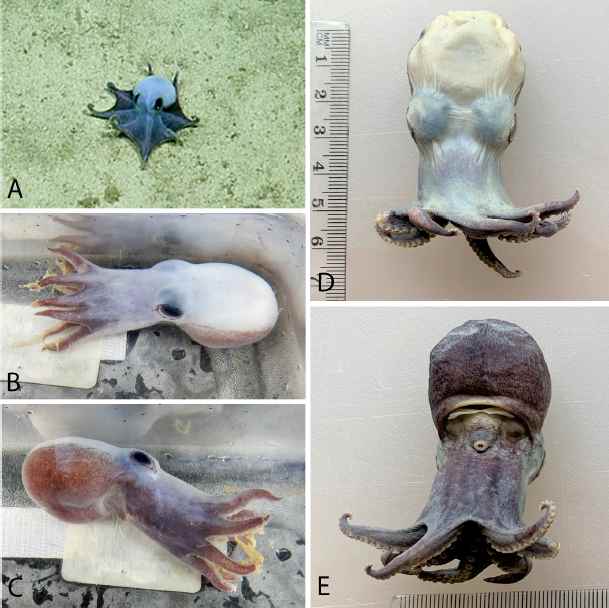
A single specimen
Once transferred to the Field Museum in Chicago, the problem was anything but minor. Formally describing a new species requires detailed analysis of its anatomy, including internal structures such as the beak, mouth and digestive organs. But in this case there was only one specimen. “I knew right away that this was something really special. I had never seen anything like it,” Voight recounted.
To avoid harming the animal, the researchers chose an avenue still uncommon in traditional taxonomy: computerized micro-tomography. Thousands of X-ray scans were digitally processed to obtain a complete three-dimensional model of the organism, allowing them to observe anatomical details normally accessible only through dissection.
“There is nothing better than spending a day observing something no other human being has ever seen,” said Stephanie Smith, CT lab manager at the Field Museum and coauthor of the study.
In the case of a unique and particularly rare specimen, the ability to obtain detailed images without using invasive procedures is one of the most relevant aspects of the research. The scans made it possible to reconstruct the animal’s anatomy in detail: short tentacles, few suckers, absence of the ink sac, and an unusual distribution of pigmentation compared to its closest relatives.
Forty years of research
The description of Microeledonegalapagensis also represents a personal milestone for Janet Voight. After more than four decades devoted to the study of octopus evolution and biology, it is the first new species that the researcher officially describes as the lead author.
“These are small octopuses that live in the deep and almost no one on Earth has ever been lucky enough to see them,” he explained. “If you took all the land and combined it, you would not be able to cover the Pacific Ocean.”
But the value of the discovery goes beyond the individual animal. In fact, the study highlights how this species forces a revision of some aspects of the classification of the family Megaleledonidae, hitherto associated mainly with large octopuses distributed in the cold waters of the Southern Hemisphere.
The presence of a small species in the equatorial waters of the Galápagos was not compatible with this definition. The researchers therefore proposed a diagnostic revision of the entire family, shifting the focus from geographic criteria to more reliable morphological features.
The Unknown Abysses of the Galápagos.
Among the first to sense the importance of the find was Salome Buglass, now a researcher at the University of California, Los Angeles, and a former Charles Darwin Foundation scientist.
“There was something unusual about that specimen,” he recalled. “Bringing it to Janet was a long process, but one that I would gladly do again if it meant learning a little more about the most precious parts of our ocean.”
Despite decades of biological research, much of the Galápagos’ deep-sea ecosystems remain underexplored. Just the oceanographic campaigns of recent years are showing a much richer and more complex biodiversity than previously imagined.
In the Galápagos, where scientific research has helped build some of the most important pages in modern biology, the deep continues to return unexpected species. Microeledonegalapagensis is new to taxonomy, but more importantly a reminder that a significant portion of ocean biodiversity still remains out of science’s field of vision.