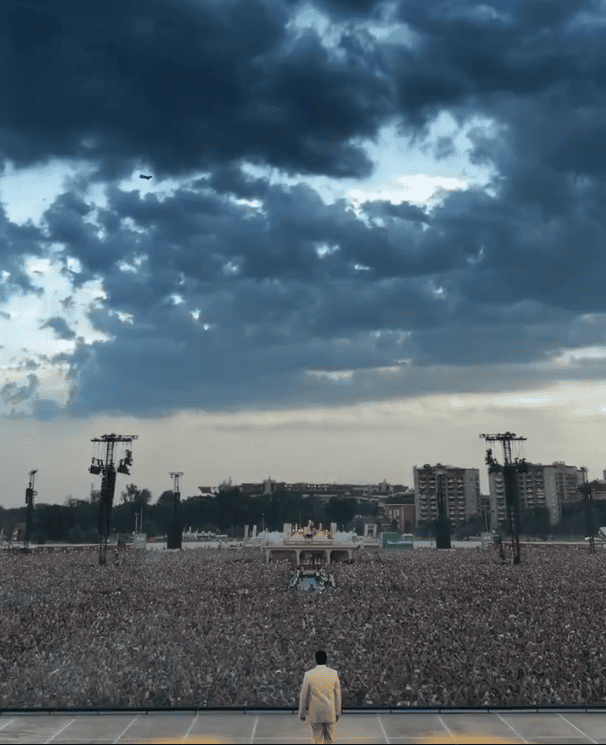
The audience had just finished singing “Bella ciao” in unison when the situation changed within a matter of minutes. Bad Bunny was performing the sixth song on the setlist when a violent hailstorm, accompanied by lightning and gusts of wind, struck the Snai La Maura Racetrack in Milan, the venue for the second and final Italian date ofthe “Debí tirar más fotos World Tour.” The hailstones, described by several witnesses as being as big as ping-pong balls, struck some spectators in the head among the approximately 80,000 people in attendance.
Concerto di Bad Bunny a Milano
— Francesca Totolo (@fratotolo2) July 19, 2026
Come è cominciato VS come è finito pic.twitter.com/uIkW1k5Pr6
The organization first urged the public, over the loudspeakers, to remain where they were in the hope that the storm would pass quickly. When conditions worsened, the Milan Provincial Fire Department ordered a complete evacuation of the area, while 118 emergency personnel provided assistance to the injured. The Uruguay M1 subway station was also closed early to ensure a safe evacuation.
Live Nation, the event organizer, announced that the show would not be rescheduled and that all attendees would receive a full refund of their ticket price and presale fees. “Due to adverse weather conditions, including thunderstorms and hail, Bad Bunny’s concert […] was interrupted and the area was safely evacuated,” the company explained in a statement (source: Adnkronos). “The safety of everyone in attendance is always our top priority,” Live Nation added, apologizing for the inconvenience caused.
Una locura la cantidad de público que había en el concierto de Bad Bunny en Milán. 🤯 pic.twitter.com/D7ZF2FJxCj
— BAD BUNNY DAILY UPDATES (@keiveiec) July 19, 2026
Not Just Milan: A Season of Events Influenced by the Weather
Bad Bunny’s case is not an isolated one. During the same weeks in July 2026, the Jethro Tull concert in Piazza Sordello in Mantua was canceled due to a violent thunderstorm with hail that struck shortly after 9 p.m. on July 11, causing fallen trees and power outages in various areas of the province (source: Gazzetta di Mantova). A year earlier, on July 6, 2025, it was Sting’s turn: 8,500 tickets had been sold for the Bassano Music Park; the Veneto Region had already issued an orange alert the previous day; the concert was confirmed and moved up by half an hour in an attempt to beat the storm front. The lawn at Parco Ragazzi del ’99 turned into a swamp even before the artist took the stage, and the concert was canceled at the last minute, amid protests from the 8,000 spectators who had already arrived at the venue.
Behind these incidents lie figures that point to a growing trend. According to Legambiente’sCity Climate Observatory, produced in collaboration with the Unipol Group, 2025 ended with 376 extreme weather events recorded in Italy, making it the second-worst year of the past decade after 2023 (383 events), with a 5.9% increase compared to 2024. The trend has not slowed in 2026: in the first five months of the year, there have already been 82 extreme events. According to ISPRA data, cited in a WWF report, Italy ranks third in Europe in terms of the severity of extreme weather events in urban areas.
Looking at the cases from the two-year period, several different situations stand out: events canceled in advance based on accurate forecasts, such as the concerts at the Cavea of the Auditorium in Rome, which were canceled on the very morning of January 2025 “due to the expected adverse weather conditions”; cases where a warning was in place but the decision to wait led to a belated and more chaotic cancellation, as was the case with Sting; and finally, incidents like the one in Milan, where the standard weather advisory had no realistic way of anticipating the onset of a hailstorm of that intensity within a matter of minutes.
When the heat even brings the game to a halt: the hydration break
While hail brought a show to a halt in Milan, another response to extreme weather has emerged in recent weeks from the world of soccer, involving the most-watched tournament of the summer: the 2026 World Cup, hosted by the United States, Canada, and Mexico.
FIFA has introduced the hydration break for the first time as a mandatory break in every match: two three-minute breaks, one midway through the first half and one midway through the second, scheduled for the 22nd minute of each half. The measure stems from the experience of the 2025 Club World Cup, held in the same U.S. stadiums, where high temperatures had already necessitated hydration breaks when a heat threshold (the so-called WBGT, the index that combines temperature and humidity) was exceeded.
The key difference from the past is that the 2026 hydration break no longer depends on the current weather conditions: it applies to every match, regardless of temperature, kickoff time, or whether the stadium has a retractable roof. This decision makes the protocol predictable for teams, referees, and television broadcasters, but it also raises a question: if the break remains the same even in covered stadiums or during matches played in cool temperatures, one wonders whether it would have been maintained even in the event of snowfall or harsh weather—a sign that organizational and commercial considerations carry as much weight as climatic factors in the decision.
It’s no coincidence that several observers have pointed out that each commercial break during a global event like this one can be worth amounts comparable to those of a Super Bowl halftime show—between $7 million and $9 million, according to an estimate by an S&P Global analyst cited by several news outlets. With 104 matches scheduled—a record number for a World Cup—the introduction of two fixed breaks per match also translates into a massive amount of advertising space.
However, there is one point that must be made just as clearly: beyond the commercial aspect, the need to ensure that players stay hydrated and get adequate rest during matches played in the height of summer—often during the day and in cities with very hot climates—is real and stems from a need to protect athletes’ health, an issue that has already emerged as a concrete concern in 2025. The fact that the measure also serves a marketing purpose does not mean that it does not, first and foremost, address a real problem. But perhaps the priorities driving these decisions need to be reevaluated.
Adapting to a Changing Climate: We Need New Music
The case of Milan, along with other incidents this season, brings a broader issue of adapting to climate change back into focus: the way in which large-scale events designed for tens of thousands of people must rethink their venues, infrastructure, and safety protocols to cope with increasingly intense and sudden weather events. Open spaces without shelter, covered escape routes, or drainage systems—which until a few years ago were considered an acceptable risk— now expose the public to real consequences when the weather changes in a matter of minutes.
At the same time, adaptation cannot be the only answer. Concerts, festivals, and major sporting events that draw tens or hundreds of thousands of people inherently have a significant environmental impact, including audience travel, energy consumption, and temporary infrastructure. Rethinking these events solely to better withstand extreme weather—without simultaneously working to reduce their environmental footprint—risks merely addressing the symptoms of a problem to which the entertainment and sports industries also contribute, albeit to a different extent than other sectors. The real challenge for the coming years seems to lie precisely in this dual approach: making events safer in the face of a changing climate, while at the same time reducing their impact on the climate itself.