More than 640 million people already live in areas where agricultural productivity has declined by at least 10% compared to thirty years ago. This figure comes from CADI (Climate-Induced Agricultural Decline Index), the new index developed by the Spanish National Research Council (CSIC), which measures the effects of climate change on the ability of land to produce food and projects how this will evolve through the end of the century.
The platform measures how much a region could produce if only climatic conditions were to change. To do so, it uses historical data from the FAO, climate data from the European Copernicus program (AgERA5), and scenarios developed by the IPCC, while keeping the crops and agricultural practices observed in 2020 constant. This is a deliberate methodological choice: to isolate the impact of climate, without confounding it with technological innovations, irrigation, new varieties, or other adaptation strategies.
Losses Are Already Occurring
The most interesting aspect of the study is that it does not merely look to the future. Change is already underway. According to the researchers, approximately 16% of the world’s agricultural land has lost more than 10% of its potential productivity compared to the 1981–2000 period. Rain-fed crops, which depend exclusively on rainfall, are the most vulnerable: nearly one-fifth have already experienced losses of more than 10%.
The phenomenon, however, is not distributed evenly. Tropical regions are bearing the brunt of the damage, while some areas at high latitudes could benefit, at least temporarily, from more favorable climatic conditions. This benefit does not offset the overall losses, however, because it affects areas that are often less productive and have more limited agricultural land.
Europe Is Divided
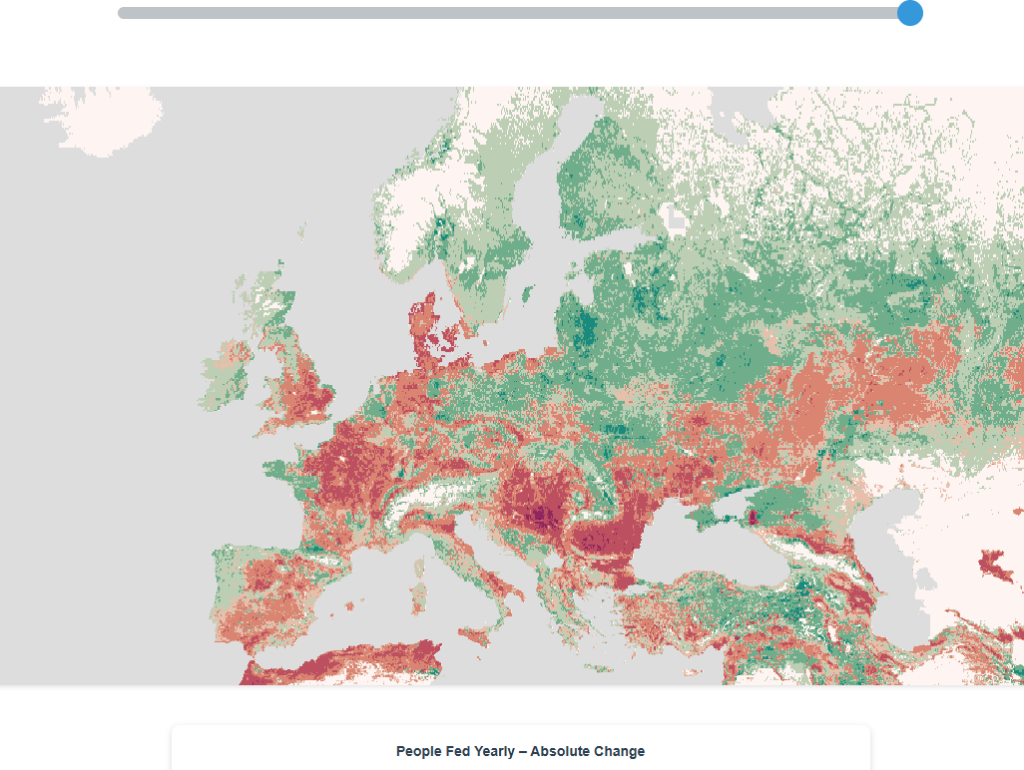
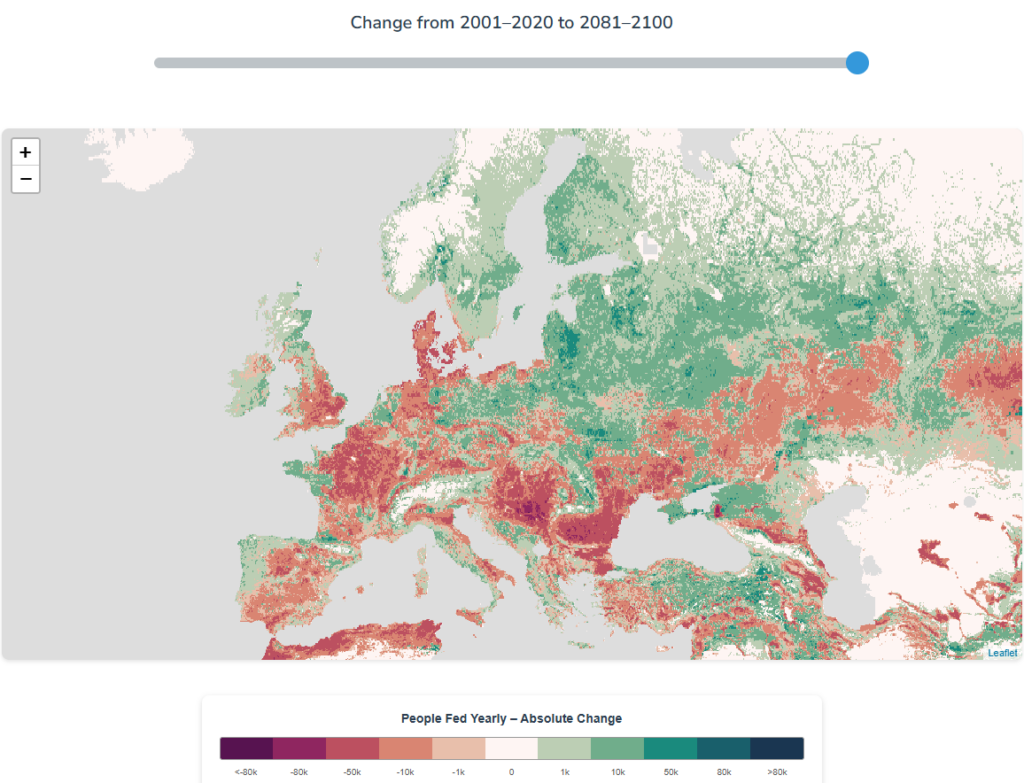
An increasingly evident divide is also emerging in Europe. Scandinavia, Scotland, and parts of the Alps are showing growing agricultural potential, while the Mediterranean region is following the opposite trajectory.
Spain is a good example of this new geography. According to Hannes Mueller, one of the project coordinators, the Cantabrian coast, Galicia, and the Pyrenees are seeing an improvement in their productive potential, while much of the interior and the central-eastern part of the peninsula is set to lose agricultural capacity. This redistribution risks altering the allocation of water, investments, and infrastructure, fueling new competition among regions.
The Challenge of Adaptation
CADI starts with a deliberately extreme scenario: it assumes that farmers will not change their crops or production techniques. This is not a prediction of what will happen, but a way to measure how much climate change alone can affect productivity.
This is precisely why researchers view the platform as a planning tool. Knowing in advance where losses will be most significant makes it possible to direct research, public investments, and adaptation strategies—from developing heat-tolerant crop varieties to introducing new crops, and even managing water resources.
A Matter of Climate Justice
The study also highlights another dynamic that is likely to weigh heavily in the international debate. The countries that have contributed the least to historical greenhouse gas emissions are, in most cases, the ones most vulnerable to declining agricultural productivity and with the least economic capacity to respond. This is one of the reasons why climate change can no longer be viewed solely as an environmental issue: it affects food security, rural development, and the economic stability of entire regions.
Projections indicate that, under the medium-high climate scenario (SSP3-7.0), between 2041 and 2060 nearly half of the world’s population could be living in areas where agricultural production potential will have declined by at least 5%. Furthermore, about one-quarter of countries will account for up to 90% of the total losses.
CADI thus provides a snapshot of the pace at which climate change is altering one of the planet’s most strategic resources: the ability to produce food. It also serves as a reminder that, without effective adaptation policies, the consequences will be felt in food prices, farm incomes, water availability, and migration patterns.