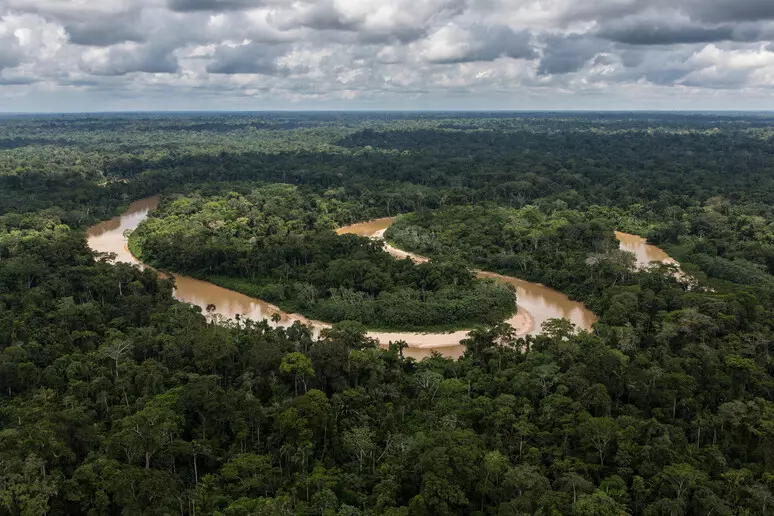
The Amazon continues to lose pieces on the state’s watch. Despite operations announced by the Brazilian government of Luiz Inácio Lula da Silva against illegal gold mining, illegal mining in protected areas and indigenous territories remains a giant business.
The latest evidence comes from a Greenpeace Brazil investigation published by the Reuters news agency. The mechanism identified by environmentalists revolves around so-called “phantom permits”: mining authorizations that are formally valid but refer to areas where mining activity simply does not exist. According to the organization’s analysis, 98 of 187 mining areas examined in the Amazon show no sign of mining. Yet 26.8 tons of gold worth an estimated $3.88 billion would have transited from those sites between 2018 and March 2026. Gold that, once “cleaned up” on paper, enters the global commercial supply chain.
The illegal gold market
The point is precisely this: the problem is not just about who digs illegally in the forest, but about the possibility of giving that metal an apparently legal provenance. It is the decisive step that allows gold mined in indigenous territories or protected areas to reach international markets without leaving obvious traces. Reuters flew over two of the areas indicated in the mining records: no visible activity, no operational quarries. A few minutes into the flight, however, reporters documented a vast illegal mine inside a protected area. A pretty clear picture of how the system works today.
Meanwhile, the price of gold continues to rise, driven by global geopolitical instability and the rush for safe-haven assets. The more the metal’s value rises, the more pressure increases on the Amazon rainforest. And public controls are struggling to keep up.
Indigenous lands under siege
Paying the highest price once again are indigenous communities. The Kayapó territory in Pará State is among the areas most affected by illegal mining expansion. Not only because of forest destruction, but because of mercury pollution that ends up in rivers and the food chain. “It destroys the land, pollutes the rivers, and indigenous people, without realizing it, end up eating poisoned fish,” Kayapó leader Megaron Txucarramãe told Reuters .
Mercury contamination linked to illegal gold mining has been documented for years by Brazilian scientific studies and health institutes. The heavy metal is used to separate gold from sediments and ends up in Amazonian waterways, accumulating in fish consumed by local people. The health consequences mainly affect children and pregnant women: neurological damage, cognitive problems, developmental disorders.
The fragility of controls
The Lula government has actually stepped up operations against illegal garimpo compared to the Jair Bolsonaro years, during which mining expansion in the Amazon had experienced a strong political and regulatory acceleration. In 2025 the Brazilian Federal Police seized 447 kilograms of illegal gold, a record figure. But Greenpeace ‘s investigation shows the structural limitation of the current traceability system. As long as it is possible to associate illegal gold with regular concessions that are difficult to verify on the ground, the market will continue to provide cover for traffickers.
Brazil’s mining agency, ANM, told Reuters it is monitoring the permits reported by the environmental organization, but admitted the “large-scale logistical and oversight challenges” in a region as immense as the Amazon. This is where the environmental issue becomes intertwined with the economic and political ones. Amazonian gold feeds local criminal networks and then enters global financial circuits, passing through refineries, international markets, and industrial supply chains. Reaching even those countries that, officially, support the protection of the tropical forest.