
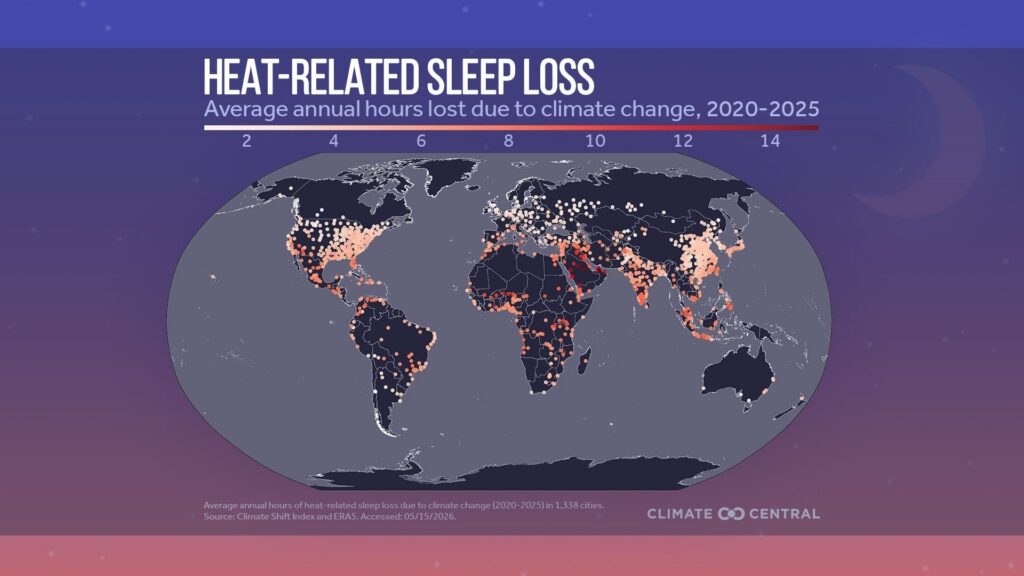
Getting a good night’s sleep is becoming increasingly difficult, and it’s not just stress or screens that are to blame. According to a new report by the U.S. scientific organization Climate Central, published on July 15, between 2020 and 2025, on average, a person lost nearly 56 hours of sleep per year due to high nighttime temperatures—the equivalent of seven full nights of rest. Of these, just over six hours—about one night—are directly attributable to warming caused by human activities.
The study, the first to quantify the hours of sleep lost due to climate change, analyzed 1,338 major cities around the world. The researchers applied a well-established relationship between nighttime temperature and sleep duration to both actual observed temperatures and those that would have been recorded in a world without carbon pollution. The difference between the two scenarios measures the sleep that climate change is robbing us of.
The Geography of Lost Sleep
The greatest losses linked to climate change are concentrated in the Middle East: in cities across Saudi Arabia, Oman, and the United Arab Emirates, residents have lost between 55 and 87 hours of sleep per year, of which 12 to 16 hours are attributable to global warming—nearly two full nights. Next are southern India and Southeast Asia, with total losses ranging from 78 to 91 hours per year, and West Africa, where cities in Niger, Nigeria, and Burkina Faso lose more than 65 hours per year.
In the United States, the average is 36 hours lost per year, with the highest figures in Arizona, California, Florida, and Nevada. In Europe, according to the report’s data, the most significant losses occur in the Mediterranean region—Italy, Greece, Spain, and southern France—while residents of Stockholm, Helsinki, and Oslo sleep almost undisturbed.
It has doubled since the 1970s
The most significant finding concerns the trend. Compared to the early 1970s, the amount of sleep lost attributable to climate change has at least doubled in 1,335 of the 1,338 cities analyzed and has at least tripled in 840. Globally, the loss has increased from about two hours per year during the 1970–1975 period to five to six hours during the 2020–2025 period.
A phenomenon like this has effects on multiple levels. First of all, sleep is closely linked to the body’s ability to cool itself, a process that hot nights hinder. But not everyone is affected in the same way: studies cited in the report indicate that the effect of nighttime heat is more than double for people over 65 compared to middle-aged adults, nearly triple for those living in low- and middle-income countries, and more pronounced for women and for those who already live in hot climates.
Air conditioning can help, but in 2021 only about 35% of households worldwide had it, and access to cooling remains strongly linked to income. Not only that: heat reduces sleep even in places where air conditioners are widespread. And since the research underlying the analysis is based primarily on data collected in the wealthiest countries, the estimates for populations with fewer resources are likely on the low side.
A Public Health Issue
The consequences go far beyond fatigue. Insufficient sleep is associated with mood disorders, a decline in cognitive function and productivity, a weakened immune system, and increased cardiovascular risks. Doctors note that adults need seven to nine hours of sleep per night, and even modest reductions, if repeated throughout an entire hot season, eventually add up. With sweltering nights becoming increasingly frequent and intense, the report concludes, sleep deprivation must be recognized as an emerging public health and productivity issue. It is yet another cost of the climate crisis that we pay with our eyes wide open, in the darkness of our bedrooms.