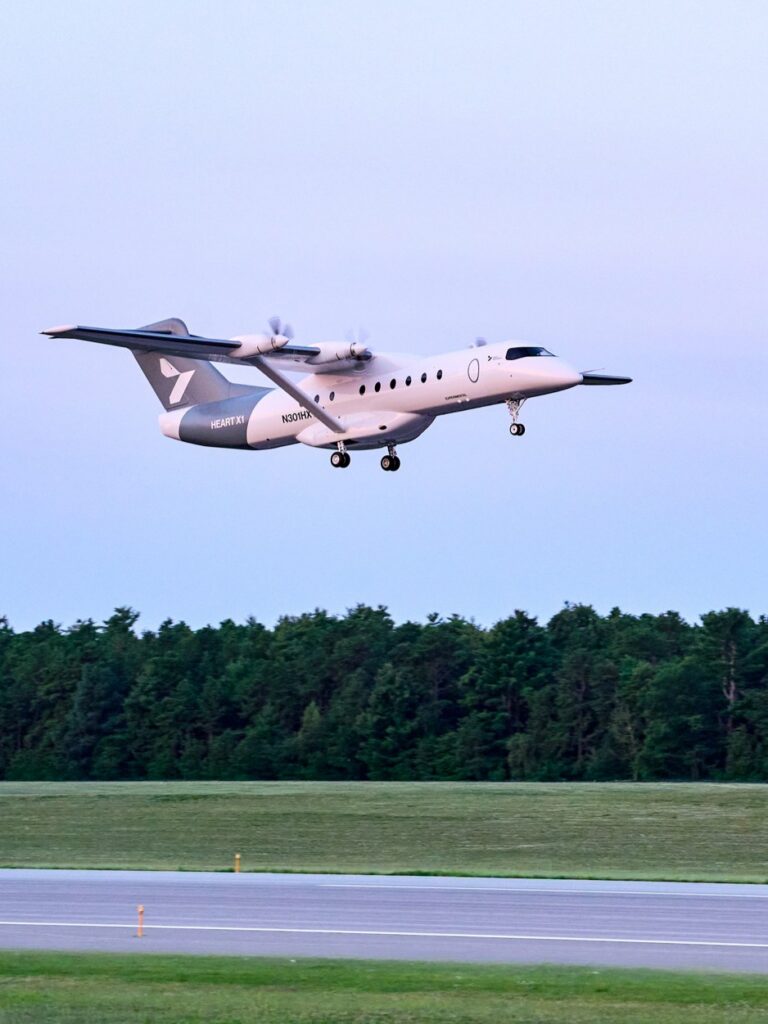
An aircraft as long as a small commercial airliner, powered solely by batteries, that stays airborne for 27 minutes while consuming the equivalent of just a few euros’ worth of electricity. This took place on August 12 at Plattsburgh International Airport in New York State, where the Swedish startup Heart Aerospace flew its X1 demonstrator for the first time, touting it as the largest all-electric aircraft ever to take off.
A wingspan of 32.3 meters
The numbers speak to the magnitude of this achievement: a wingspan of 32.3 meters, a length of over 23 meters, and a maximum takeoff weight exceeding 11 metric tons. During the mission, which lasted less than half an hour, the aircraft reached an altitude of approximately 335 meters, completing all the main phases of flight: taxiing, takeoff, climb, basic maneuvers, and landing. The propulsion system delivered more than one megawatt, while the energy consumed would have cost just five dollars—a little over 4 euros.
That figure, however, tells only part of the story: it refers to raw electricity and does not include crew, maintenance, insurance, or the degradation of the batteries over time. In short, rather than an aircraft ready for commercial routes, the X1 is a flying laboratory. It is used to test aerodynamics, battery thermal management, and control systems on an airframe comparable in size to that of a commercial aircraft.
The goal is to collect data to developthe ES-30, the product the company is truly focusing on: a 30-seat hybrid-electric regional aircraft designed for short-haul flights between small airports. The model is expected to have a total range of approximately 805 kilometers, of which just over 200 can be traveled in all-electric mode, with zero emissions.
Interest from Several Major Airlines
The project has already attracted the interest of several major airlines, including United Airlines, Air Canada, and JSX, which view the X1’s maiden flight as a significant technical milestone. The first ES-30 prototype is under construction at the Los Angeles facility: flight tests are expected in 2028, while entry into service is targeted for 2031. This is an ambitious timeline, given the lengthy development and certification processes typical of the industry.
There remains one fundamental obstacle: batteries. Aviation needs energy storage systems that are much lighter and have a much higher energy density than those used on the ground, because every extra kilogram directly affects fuel consumption and range. Energy density is, for now, the true litmus test for electric flight.