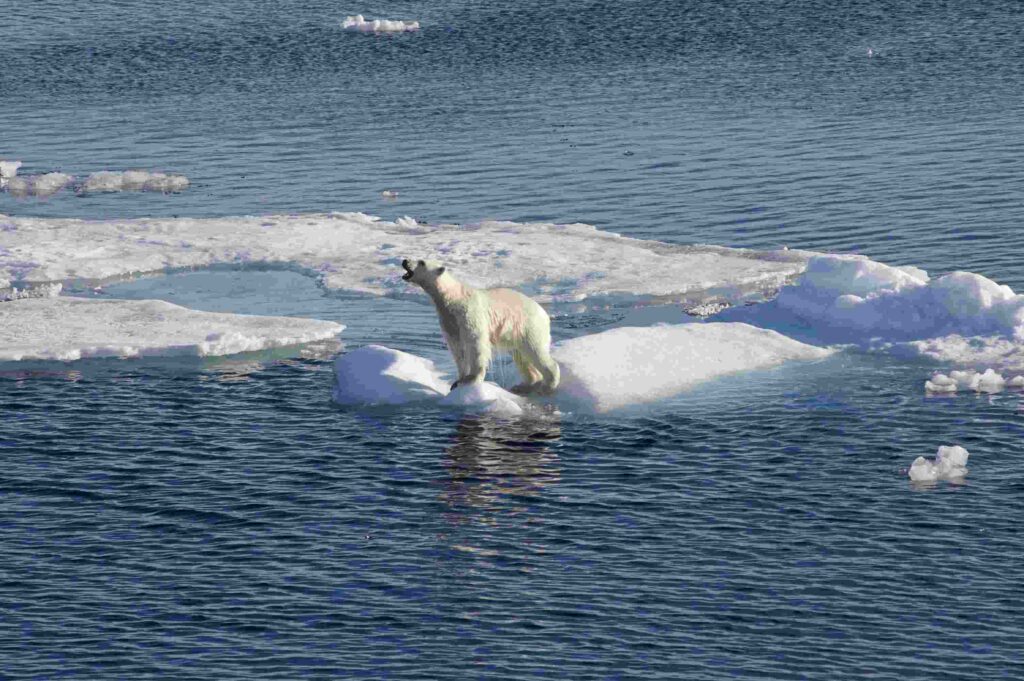
Until recently, part of the scientific community viewed data on winter Arctic sea ice with cautious relief: between 2016 and 2024, the rate of melting had slowed. A new study published in PNAS, authored by a research team from the University of Southampton in collaboration with the UK’s National Oceanography Center, puts an end to that interlude: the winters of 2025 and 2026 brought Arctic sea ice back to record levels, and the decline is once again clear and measurable with statistical certainty.
An Unprecedented Collapse
Between 2024 and 2025, sea ice extent during the seasonal peak—February–March—declined by 5.8%: the sharpest annual decline since satellite observations began in 1978. The year 2026 confirmed this trend: the growth phase, between November and January, reached a new all-time low of 11.3 million km², while the winter peak, although rising slightly, remained the second-lowest value ever recorded.
By including these two years in the calculation of the 20-year trend, the researchers observed a clear reversal of the decline, which was significant in both seasonal phases analyzed and confirmed by two different, independent satellite datasets.
The most likely direction
By comparing the observed data with simulations from the CMIP6 project, the team investigated whether such a sharp decline was consistent with the current rate of Arctic warming, estimated at 2.8 °C. The answer is that the 2025 event is rare but consistent with this climate scenario. Projections based on similar cases also indicate that a rapid return to early-decade values is unlikely: a stabilization at structurally lower levels is more plausible, with a probability greater than 75% that the decline will remain statistically significant at least through 2030.
“At current rates of warming, Arctic winter sea ice is more likely to continue fluctuating at reduced levels in the coming years, rather than quickly returning to the conditions seen at the start of the decade,” explained Simon Josey, a co-author of the study. For the lead author, Duo Chan, the key point concerns the interpretation of the phenomenon: what appeared to be a pause was actually a temporary slowdown within a long-term decline linked to global warming.
A balance that also affects the mid-latitudes
Winter sea ice separates the relatively warm Arctic Ocean from a much colder atmosphere. As it thins, more heat and moisture are allowed to rise, with potential consequences for storm formation and atmospheric circulation—effects that can be felt even far from the Pole.