Traveling without consuming places has become difficult, almost a luxury. Yet, among the folds of rural Spain, moving slowly is still possible. Fewer crowds, more nature and the certainty that your money will end up in the hands of those who inhabit and guard that land.
On the road, on your own and willing to get your shoes dirty with dust: here are six destinations that might be right for you.
Aragon
Aragon, which lies inland in northeastern Spain, is one of those regions that almost never ends up in the top choices, and that is precisely its strength.
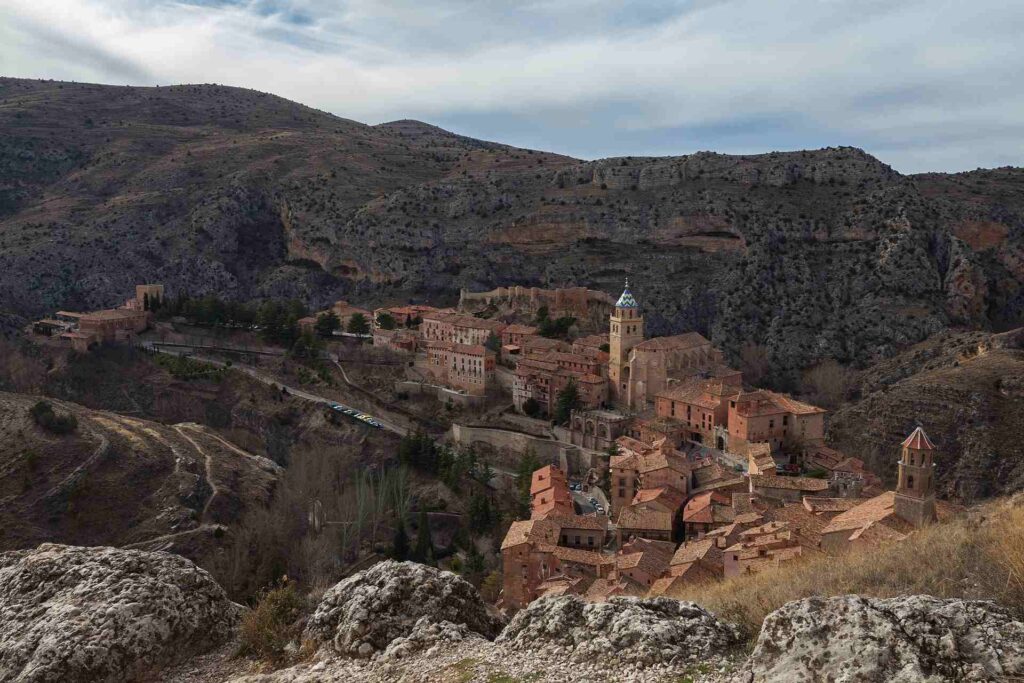
Albarracín, a UNESCO World Heritage nominee, is probably the most spectacular medieval village in this region. It climbs nearly 1,200 meters on a rocky outcrop surrounded by a meander of the Guadalaviar River, with its earth-colored houses and walls that follow the contours of the hillside. Nearby are the Pinares de Rodeno, a protected area with rock shelters that preserve Levantine rock art that has been declared a UNESCO World Heritage Site.
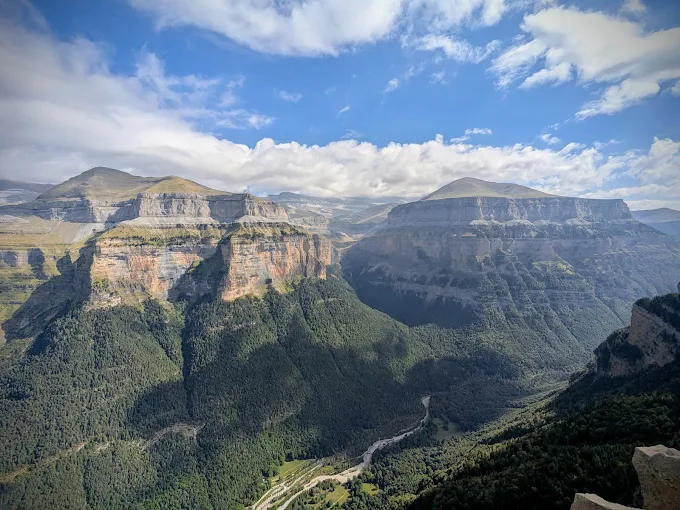
From there one can ascend to the villages of Aínsa and Alquézar. Aínsa, located at the confluence of the Cinca and Ara rivers and declared a Histórico-Artístico Monument, is one of the gateways to the Ordesa and Monte Perdido National Park, with its church of Santa María-one of the most important symbols of Aragonese Romanesque. Alquézar, on the other hand, has been recognized as the World’s Best Tourist Village in 2022 by the World Tourism Organization: it lies at the foot of a castle of Islamic origin converted into a collegiate church, while the Vero River flows through its canyon before opening up to the valley.
Everything here invites a slowdown, and accommodations are often carved out of carefully restored historic buildings.
Inland Andalusia
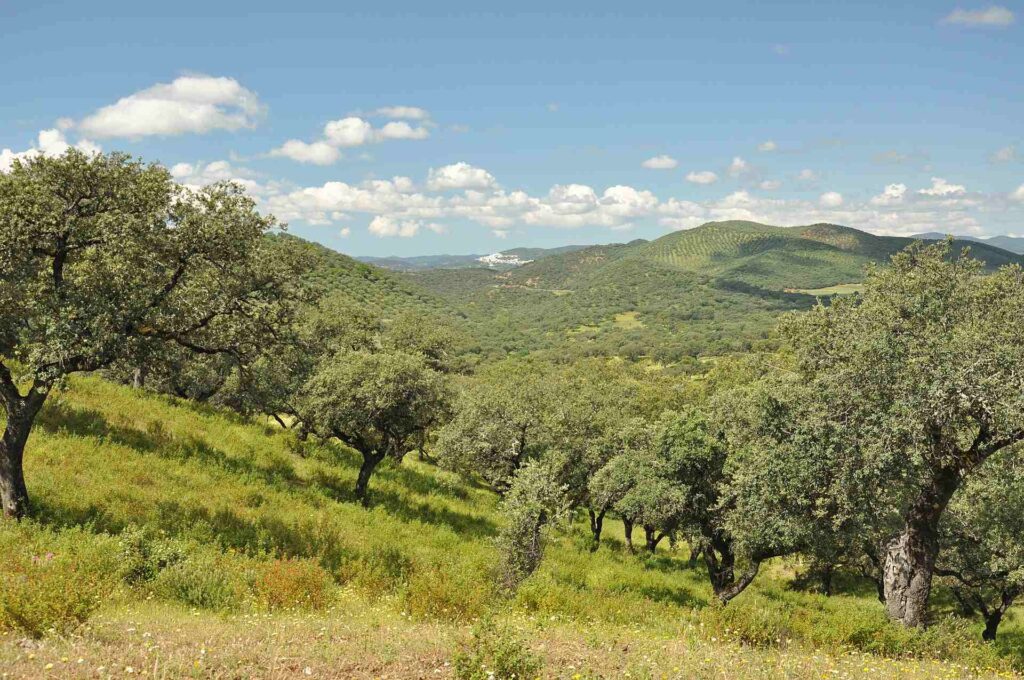
Far from the most visited cities, the Andalusian hinterland is changing its face. The Sierra de Aracena and Picos de Aroche was awarded a “Biosphere-certified destination” certificate in 2022. The area boasts an exceptional heritage-from the Gruta de las Maravillas to the Peña de Arias Montano-and a gastronomy based on products such as Jabugo’s Jamón Ibérico, gurumelo mushrooms, and chestnuts. The area offers visits to dehesas – extensive pastures – to discover Iberian pig breeding, artisanal cheese-making workshops and guided tastings.
Moving toward the Alpujarras, in the foothills of the Sierra Nevada, the landscape is further transformed. The Barranco del Poqueira is home to three of the area’s most picturesque villages: Pampaneira (about 1,000 meters above sea level), Bubión with its labyrinth of Moorish alleys, and Capileira (1,436 meters), an ideal base for hiking in the Sierra Nevada. The artisan tradition dates back to the Neolithic period, more than 4,500 years ago: jarapas (carpets), leather goods, pottery, and duesparto fiber objects are still produced today.
Galicia and Asturias
In Galicia, seafood tourism offers unrepeatable experiences: accompanying mariscadoras in harvesting cockles, clams or cannolicchi on the beach; getting close to the tanks where mussels are raised; or witnessing the audacity of percebeiros who harvest percebe-a type of shellfish-defying the waves. Cambados -capital of Albariño wine and seafood sanctuary- is home to historic wineries such as the Pazo de Fefiñáns (active since 1904) and a Museo Etnográfico e do Viño housed in an old 16th-century rectory.
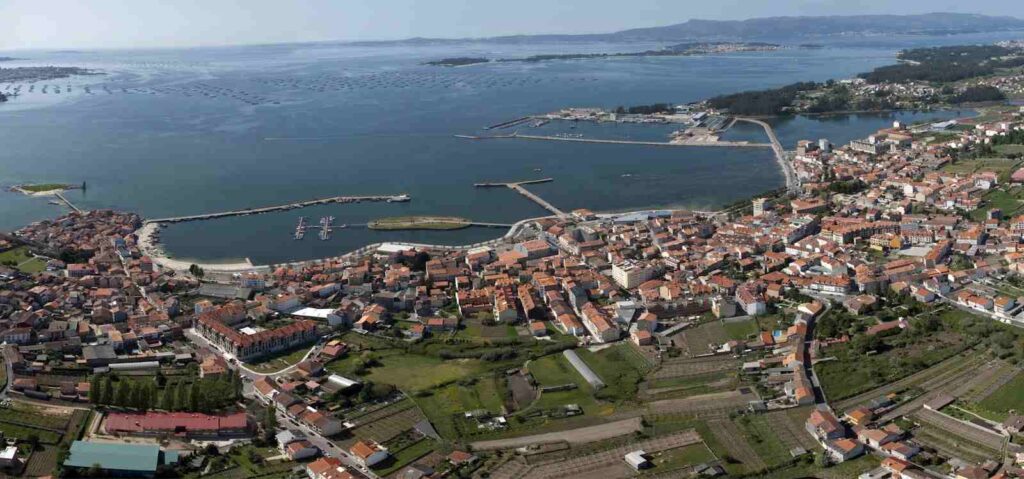
Heading up to Asturias, the landscape opens up to verdant pastures, pine and fern forests that reach down to the beaches, with predominantly local tourism and an almost complete absence of international brands. So-called “Green Spain”- which includes Galicia, Asturias, Cantabria and the Basque Country-has more than 20,000 beds in rural accommodations, more than 100 ecotourism businesses and 118 certified ecotourism experiences. 33% of its area is protected natural landscape.
La Garrotxa
In Catalonia, the Garrotxa volcanic area is one of the most interesting examples of sustainable land management. The region has 26 nature reserves and is considered the largest and best-preserved volcanic area on the Iberian Peninsula: there are 40 inactive volcanic cones and more than 20 basaltic lava flows in the park. Among the most striking volcanoes is that of Santa Margarida, near the medieval village of Santa Pau: a small Romanesque church nestled in a valley surrounded by holm-oak forests springs up inside the caldera.
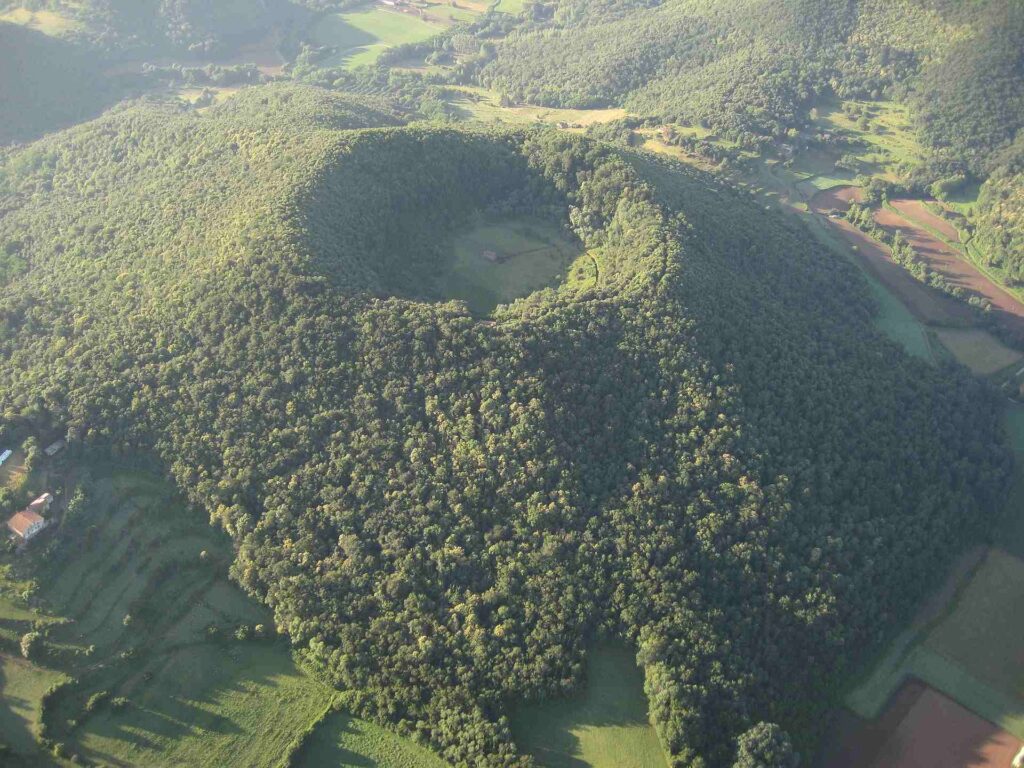
Olot, Santa Pau, Rupit: small towns, but full of character. Olot is surrounded by four volcanoes-Montsacopa, Montolivet, Garrinada, and Bisaroques-and is home to contemporary buildings by Studio RCR, winner of the 2017 Pritzker Prize. Local volcanic cuisine emphasizes white beans, corn, game, black truffles, and typical Olot potatoes. The Ruta del Carrilet connects Olot to Girona along the route of an old railway, with stops at medieval villages along the way. Those who want to go up in a hot air balloon can rely on Vol de Coloms, which organizes flights departing from Santa Pau.
Basque Country and Navarre
Between coast and hinterland, this itinerary is among the most varied. On one side is the ocean with its unique cliffs and rock formations; on the other are green valleys, bike paths carved out of old railways, and small towns where tradition is still part of everyday life.
Lekunberri, named among the “Best Tourism Villages” by the World Tourism Organization, is a good starting point for exploring the area: the Plazaola bicycle path starts here, which follows the route of an old railway through meadows and forests. The Plazaola Green Way stretches about 68 kilometers northward, crossing Navarre and Gipuzkoa with tunnels, historic bridges, and mountain landscapes.
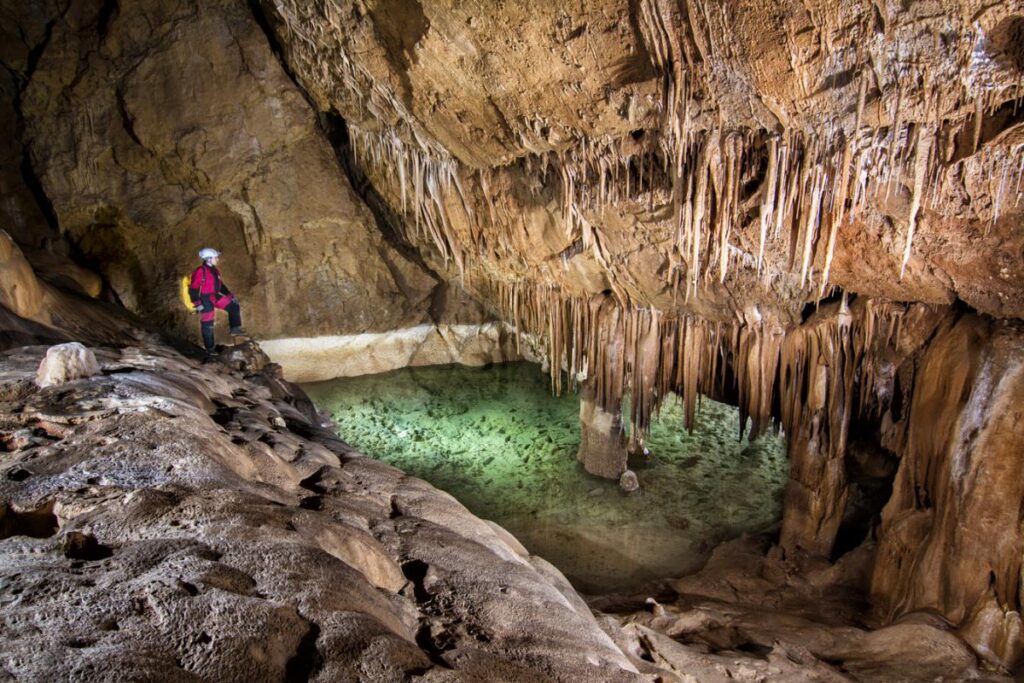
Mendukilo Caves are located in the Sierra de Aralar, 750 meters above sea level: used since the early Iron Age, it is now equipped with suspended walkways and dynamic lighting. The guided trail winds 540 meters through three halls, descending to 40 meters underground. Caving tours are also available for the more adventurous.
Between Castilla-La Mancha and Andalusia
The Almadén Mines, in Ciudad Real, are part of the UNESCO site “Mercury Heritage: Almadén and Idrija“: one of the world’s largest mercury deposits, exploited from Roman times until recent times, has been restored and transformed into a Mining Park. It is estimated that more than 250,000 tons of mercury were extracted from its galleries. The park offers tours of the tunnels excavated between the 16th and 18th centuries, the Mercury Museum and the former Royal Mining Hospital.
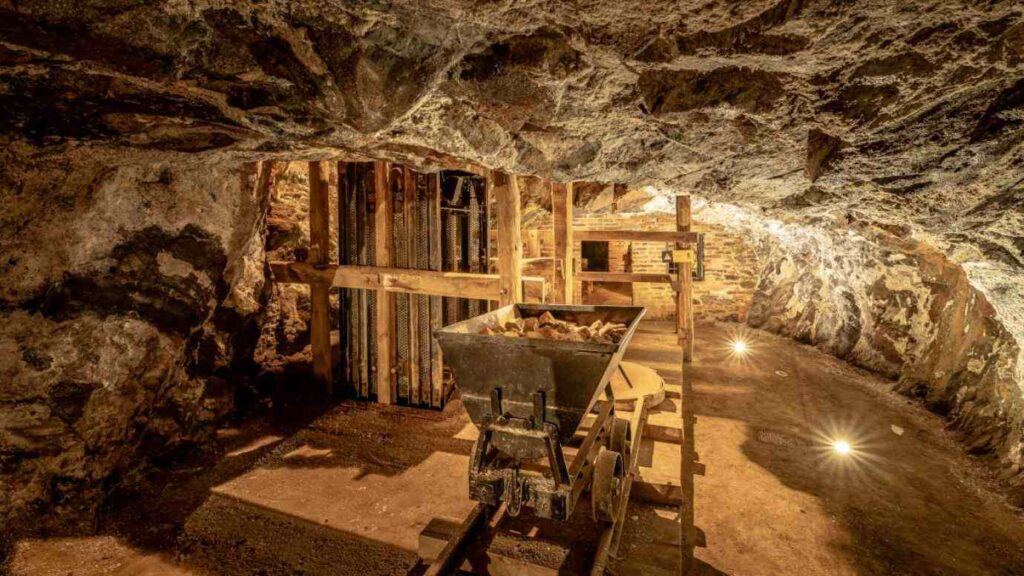
At Riotinto, the landscape contributes greatly to the experience: intense, almost unreal colors. The Mining Park offers several visit alternatives, including the interior of the mine and 12 kilometers of the old commercial line that can be traveled aboard a restored mining train. The park was a finalist in the European Commission’s EDEN (European Destinations of Excellence) program. The museum is housed in the old Compañía de Riotinto hospital-the first museum of its kind in Spain-and holds the “Maharaja wagon,” built for a trip by Queen Victoria that never took place.