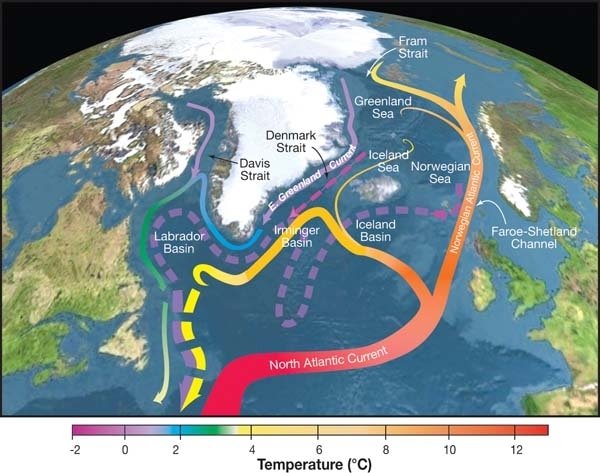
There is a huge, invisible machine that has been working continuously for millennia beneath the surface of the Atlantic. It is called AMOC-the Atlantic Meridional Overturning Circulation-and it is one of the most complex and decisive systems in Earth’s climate. It works like a giant conveyor belt: warm water goes from the tropics northward, giving up heat to the atmosphere; then, when it has become thick and cold by now, it descends into the deep and begins the journey back south. This continuous cycle fuels the mild climate of northwestern Europe, regulates rainfall in Africa and the Americas, and keeps much of the global climate system in balance.
Today, this thermal machine shows worrying signs of breaking down. A new study published in April 2026 adds an element that scientists call “very worrisome”: the models that predict the most drastic slowdown in AMOC are those that best reproduce observed reality. In other words, the most pessimistic projections also appear to be the most accurate.
Closer to the point of no return
The AMOC was already known to be at its weakest level in 1,600 years as a consequence of the ongoing climate crisis: signs of a possible point of no return had been identified in 2021. What changes with the new study is the probability assessment: the most realistic climate models-those that best mimic the real behavior of the oceans-are precisely the ones that show the most intense slowdown.
This is not an imminent collapse; it is not a phenomenon that can happen in a few years. But the direction is clear. Analyses based on dozens of different models indicate that the AMOC could begin to decline around mid-century, in a range that depends on greenhouse gas emission scenarios: the more emissions go up, the closer the date gets.
Meanwhile, a research team atUtrecht University has identified a possible precursor signal to collapse hidden in the movements of the Gulf Stream. An abrupt northward shift in the current-observed in both high-resolution models and real data-could be a wake-up call.
Europe, a continent that could freeze over
What would happen if the AMOC collapsed? The consequences for Europe would be of a magnitude difficult to imagine. Under an intermediate emissions scenario, simulations show London winters with highs near -20°C, and winter lows in Norway that could drop to around -48°C. Sea ice would extend as far as the coasts of Scotland, the Netherlands, and Scandinavia, further amplifying cooling by albedo, or the ability of white surfaces to reflect sunlight.
This is not catastrophist science fiction: it is the result of simulations conducted with complex, up-to-date climate models. But cold weather would not be the only threat. A weakening of the circulation would also lead to reduced precipitation in Europe, faster sea level rise along Atlantic coasts, severe disruptions of tropical monsoon systems, and cascading effects on other critical points in the climate system. Atlantic storms would intensify, with increasingly extreme daily temperature swings.
All this while Europe is getting warmer, and will get warmer. And this is the paradox: in a warmer world, some regions may find themselves in extreme cold. A reversal that lays bare the complexity of the climate system and the ease with which simplified representations can mislead us.
The scientific debate
Actually on AMOC, the science is not monolithic. There are studies that offer a less alarming picture. Some research shows that the 10-year average of the circulation has not weakened significantly in recent decades, and that the current has shown some resilience even under conditions of sharp increases in greenhouse gases. Other scientists point out that precursor signals interpreted as warnings of impending collapse may not be as robust as they seem.
The debate is therefore open. But there is an important difference between scientific uncertainty and reassurance. Uncertainty – in this case – concerns the timing and intensity of the phenomenon, not its direction. The trend is one of gradual weakening, and the most accurate models indicate that we may be closer to the tipping point than previously thought.
A system that has failed before
After all, the AMOC has collapsed before: it happened about 12,900 years ago, when the accelerated melting of a huge North American glacial basin poured huge amounts of fresh water into the oceans, triggering the Recent Dryas, an abrupt cooling that lasted more than a millennium.
More recent research shows that even large volcanic eruptions have historically had the ability to destabilize the Atlantic circulation, causing sudden climate changes lasting centuries or millennia. Today, a climate system already weakened by the massive input of greenhouse gases into the atmosphere is much more vulnerable to perturbations.
Faced with this scenario, the global policy response appears wholly disproportionate, in stark contrast to the indications of the scientific community. Countries that contribute the most to greenhouse gas emissions continue to proceed with very slow adjustments and downward negotiations.as if the climate crisis were a problem to be managed over an indefinite future.
Instead, scientists are calling for immediate action: more measurements, more data, more cuts in greenhouse emissions. And they warn. The AMOC system has a fearsome feature: once the point of no return is passed, there is no turning back in time compatible with a human life. It would take centuries, perhaps millennia. It is the climatic tipping point: not a boundary that allows one to pass over and over again, but a threshold beyond which the system reorganizes itself stably, over a long period, on a different equilibrium. A different one that, in this case, has the face of polar winters in the latitudes of London and Amsterdam.