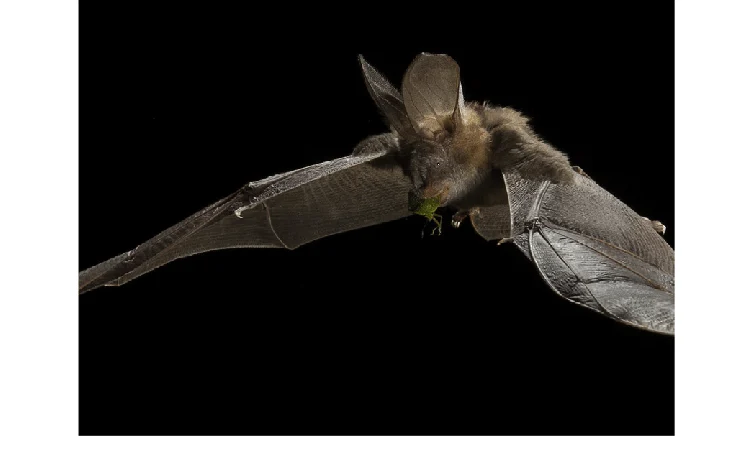
A zoological mystery that had remained unsolved since the 19th century has been solved on the island of Pantelleria. An international research team has recorded, for the first time, acoustic evidence of the presence in Europe of the Egyptian slit-faced bat, Nycteris thebaica, a species widespread across much of sub-Saharan Africa but never before confirmed north of the Mediterranean. The study, published in *Global Ecology and Conservation*, was conducted by researchers from the University of Naples Federico II, the Berlin Museum of Natural History, Humboldt University of Berlin, and the Pantelleria National Park.
A 19th-century reference that has never been verified
The species had already appeared in Sicilian scientific literature two centuries ago, but under an uncertain name and without any concrete evidence: no preserved specimens, no precise location, no diagnostic description. For generations of zoologists, it remained a dubious report, neither confirmable nor refutable. A technical detail solved the mystery: Nycteris thebaica flies at low altitudes and emits faint echolocation calls that are difficult to detect with standard monitoring systems, which position microphones higher above the ground.
Ground-level microphones
In June 2026, the team installed two recorders less than half a meter above the ground, set to maximum sensitivity, in a holm oak forest on the island’s highest elevation. In a single night, approximately 30 gigabytes of audio files were collected. This yielded 54 vocalizations that could be definitively attributed to the species, distributed across five sequences. One of these sequences featured two individuals flying simultaneously, along with social calls that, according to the researchers, indicate the presence of a small, stable population—not a single stray individual.
A Bridge Between Africa and Sicily
In recent years, Pantelleria has already emerged as a transit point for other species of North African origin identified on the island, such as Plecotus gaisleri and Myotis punicus. During periods of falling sea levels in the Mediterranean, the distances to be crossed by sea were reduced, making colonization by even slow-flying bats more plausible. The researchers, however, rule out the possibility that this is a recent effect of global warming: the species’ limited dispersal capacity and historical reports from the 19th century suggest instead that a peripheral population has been present for some time, but had simply never been detected.
Danilo Russo, the study’s lead author, summarizes the significance of the discovery as follows: “Our study transforms a historical uncertainty into a conservation issue.”
Now we need to protect it
This confirmation adds not only a new species to Europe’s fauna but also the first member of the Nycteridae family ever documented on the continent. Several questions remain unanswered: how large the population is, where it takes refuge, and whether it is also present elsewhere in Sicily. Among the threats identified by the researchers are forest fires and stray cats, which are particularly widespread on the island and potentially lethal to a species that flies close to the ground. Funding for the research came from the Pantelleria National Park, the Alexander von Humboldt Foundation, and the German Heidehof Stiftung.