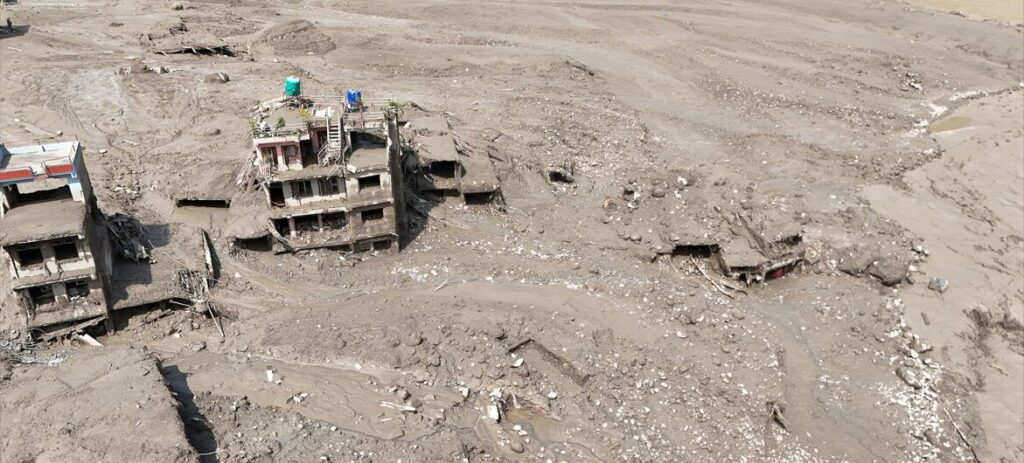
In Nepal, the most difficult phase of the emergency may have just begun. Two days after the flash flood that devastated the Himalayan valleys along the border with China, the lake that formed after the massive landslide has begun to overflow, forcing a temporary halt to rescue operations and driving residents of the most vulnerable areas to higher ground.
This is a second source of risk emerging while the first disaster is still unfolding. The death toll continues to rise: according to the latest figures reported by Nepalese authorities, 547 people have died in Nepal; on the Tibetan side, five deaths have been confirmed. A total of more than 1,500 people are missing. The Red Cross also estimates that more than 90,000 people have been affected by the disaster.
A lake that formed in just a few hours
This sequence is typical of cascading disasters that can occur in mountainous areas. The collapse of a mass of ice and rock deposited enormous quantities of debris, mud, and solid material into the waterways. The blockage of a section of the river system led to the formation of a temporary reservoir.
On Friday, the volume of accumulated water was estimated at over 2.5 million cubic meters, up from the previous day’s estimate. When the lake began to overflow into the Bhotekoshi River, Nepalese authorities ordered rescue workers and residents to evacuate the most vulnerable areas. Operations were suspended for about 90 minutes.
Narendra Pariyar, a senior official in Rasuwa District, confirmed that the lake had overflowed its banks: “However, we don’t know how large the lake is or how high the water has risen. We can only observe that the river level is rising,” he told Reuters.
The situation is therefore extremely dynamic. On the one hand, water is flowing out; on the other, the reservoir can continue to receive sediment and precipitation. On the Chinese side, authorities have indicated that the risk is expected to gradually decrease, reporting that natural outflow will exceed inflow. According to Chinese state media, the lake’s level has dropped by about ten meters from the peak reached on August 27.
Providing assistance becomes more difficult
The problem is operational. Every hour lost in the search efforts can be critical for those who are still alive, but sending personnel and equipment into an area where river levels can change rapidly also puts the rescuers at risk.
The disaster has already destroyed dozens of bridges and damaged about 40 kilometers of roads, cutting off entire communities. Army helicopters have become essential for reaching areas that are now cut off from ground transportation. On Friday, they were also working to evacuate people trapped in a tunnel at the Trishuli 3A hydroelectric project.
The international dimension of the tragedy further complicates the situation. Among those missing are hundreds of foreigners: tourists, hikers, and pilgrims heading to Tibet. The Guardian reports that 177 Indian citizens, 90 Americans, 34 Australians, 33 Britons, and 25 Canadians are among those still unaccounted for on the Nepalese side. In Tibet, 558 people are also missing, at least 260 of whom are foreigners.
The Issue of Prevention
Recent news reports show just how quickly an extreme event can trigger a chain of related hazards: a glacial collapse, a flash flood, a landslide, the blockage of rivers, the formation of a lake, and finally, the risk of another flood.
For this reason, attention is also shifting to monitoring glacial lakes and temporary reservoirs created by landslides. Chinese President Xi Jinping has called for enhanced monitoring of risks associated with glaciers, landslides, and glacial lakes, while Beijing has coordinated rescue operations in the Tibetan region.
In this case, the environmental issue coincides with a civil protection concern: continuous monitoring of glaciers, unstable slopes, and waterways blocked by debris. It is the ability to interpret these signs before they turn into a new flood wave that determines how much time remains to evacuate people and organize rescue efforts.
Meanwhile, Nepal has chosen to manage its search and rescue operations independently, declining offers of assistance from foreign teams for the time being. The government maintains that its own resources are sufficient. South Korea has an emergency response team already in Kathmandu, but it has not yet been authorized to intervene.
The priority remains finding the missing. But the new lake has introduced a variable that did not exist until a few hours ago: while searching for survivors of the flood, we must also prevent the mountain from triggering a second emergency.