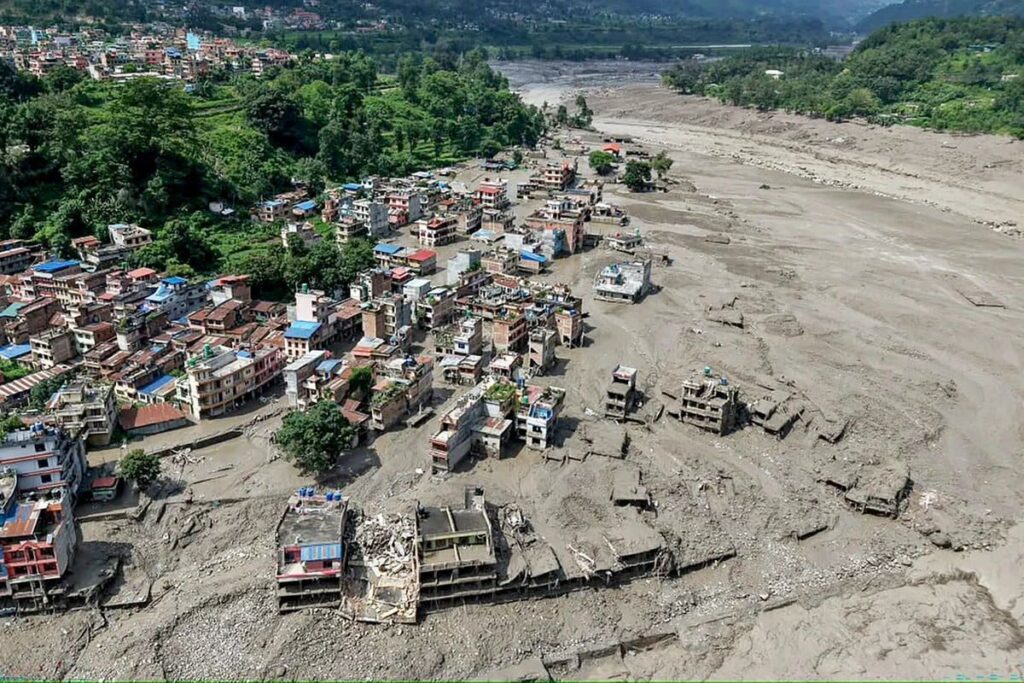
The death toll continues to rise as the search for the missing continues in Nepal. At least 165 people have died following the flood that struck the Himalayan region on the border with Tibet on Wednesday. The number of people unaccounted for exceeds 1,000 when including the Tibetan side, but authorities warn that the tallies from the two countries may overlap.
Devastating flash flood hits Nepal’s Rasuwa district 💔
— SUNITA (@SaffronSunita) August 26, 2026
Lives lost. Hundreds still missing including Indian tourists and Kailash pilgrims.
Bridges and roads washed away. Rescue teams working through the day.
May Mahadev protect everyone. 🙏#Nepal pic.twitter.com/7PlVpr2zNo
The sequence of events reconstructed so far points to a phenomenon that occurred at high altitude: according to the U.S. Geological Survey, a glacial collapse followed by a debris flow caused the devastating effects observed downstream. The activity, initially interpreted as a possible seismic event, is therefore believed to be linked to the collapse of the ice and the mass of mud and rock that swept through the river system.
The floodwaters have washed away roads, bridges, and transportation links
In Nepal, the flooding has primarily affected areas along waterways, causing severe damage to homes and infrastructure. Verified videos show masses of water and debris reaching the Gyirong Pass, while on the Nepalese side, roads, bridges, and power plants have been damaged or swept away.
The geography of the disaster is now making it particularly difficult to reach people who are cut off. More than 5,000 military personnel and police officers are involved in the operations. Helicopters are being used to search for survivors and deliver aid to areas that cannot be reached by land. Today, 125 people were rescued, including 20 foreigners.
Further complicating rescue efforts is another factor reported by Chinese authorities: upstream from the Gyirong Pass, there is still a lake that has been dammed, and its potential evolution could create additional problems in an area already affected by landslides and floods.
An event linked to the climate crisis
The earthquakes with magnitudes of 4.4 and 5.2 recorded in the area appear to have been an effect, but not the cause, of the landslide: the sequence was likely triggered by the collapse of a glacier, as confirmed by USGS data. This is also what geologist Mario Tozzi noted on social media.
The collapse of high-altitude glaciers is a phenomenon that scientists are increasingly linking to global warming: rising temperatures weaken permafrost and destabilize hanging glaciers, making sudden collapses more likely—collapses that turn into flows of mud, water, and debris. Tozzi himself has emphasized that, against the backdrop of the ongoing climate crisis, safety in mountain areas can no longer be taken for granted, necessitating a reevaluation of human presence at high altitudes. The Himalayas, home to some of the planet’s largest glaciers outside the polar ice caps, is one of the regions where these processes are being monitored most closely by the international scientific community.
Hundreds of foreigners with no contacts
The international aspect of the tragedy is extensive. In Nepal, hundreds of tourists and travelers from more than twenty countries were reported missing. Among the figures released are 142 Indian citizens, 53 Ukrainians, 34 Australians, 12 Britons, 17 Malaysians, and nine South Korean workers. The Nepalese tourism authority also reported that 93 Nepalese citizens remain missing.
The number of Italians affected is, for now, more limited. The Italian Ministry of Foreign Affairs reported that two Italian citizens and their guide were stranded upstream of a landslide and are receiving assistance. According to information available to the ministry, there were approximately 90 Italians in Nepal and Tibet.
On the Tibetan side, the situation is just as serious. China’s state-run television network CCTV reports 558 people missing in Gyirong County, 260 of whom are foreigners, while the confirmed death toll stands at three. The apparent total thus exceeds 1,000 people, although it is not yet possible to determine with certainty how many are actually accounted for in the two tallies.
The Interrupted Pilgrimage
A significant number of those affected were in the region for religious tourism. Their destination was Mount Kailash and Lake Mansarovar, sites sacred to Hindus and Tibetan Buddhists. According to an account reported by The Guardian, dozens of pilgrims were inside the immigration building when the mass of mud and debris reached the pass. This information has not yet been independently verified.
Here, too, the figures are incomplete. Australia has reported 34 missing citizens; 15 of them, according to the agency that organized the trip, were on a pilgrimage to Mount Kailash. The group also included an 11-year-old boy.
The international scope of the emergency makes it even clearer just how difficult it is to manage an emergency in a mountainous region where communications have been cut off and roads are blocked. A witness on the Tibetan side reported finding trees and utility poles that had already been knocked down by the floodwaters and said she had to turn back to save herself.
For now, there is only one priority: reaching those who may still be alive. The death toll, Nepalese authorities warn, could rise. And while helicopters continue to fly over the valleys, the hardest figure to grasp is the number of people still unidentified and unaccounted for: hundreds of families, in Nepal and in many other countries, are waiting to find out if the mountain that collapsed left anyone behind who still needs to be brought home.