The IgNobels—the parody awards modeled after the Nobel Prizes and presented by the journal *Annals of Improbable Research*—have moved to a different continent for the first time after thirty-five editions, all of which were previously held at Harvard and MIT in Boston. Founder Marc Abrahams explained the decision to move to Zurich by noting that the climate in the United States made it risky to ask winners and journalists to cross the ocean. Even the most lighthearted science, it seems, cannot escape the political context in which it is honored.
Soil is measured with underwear
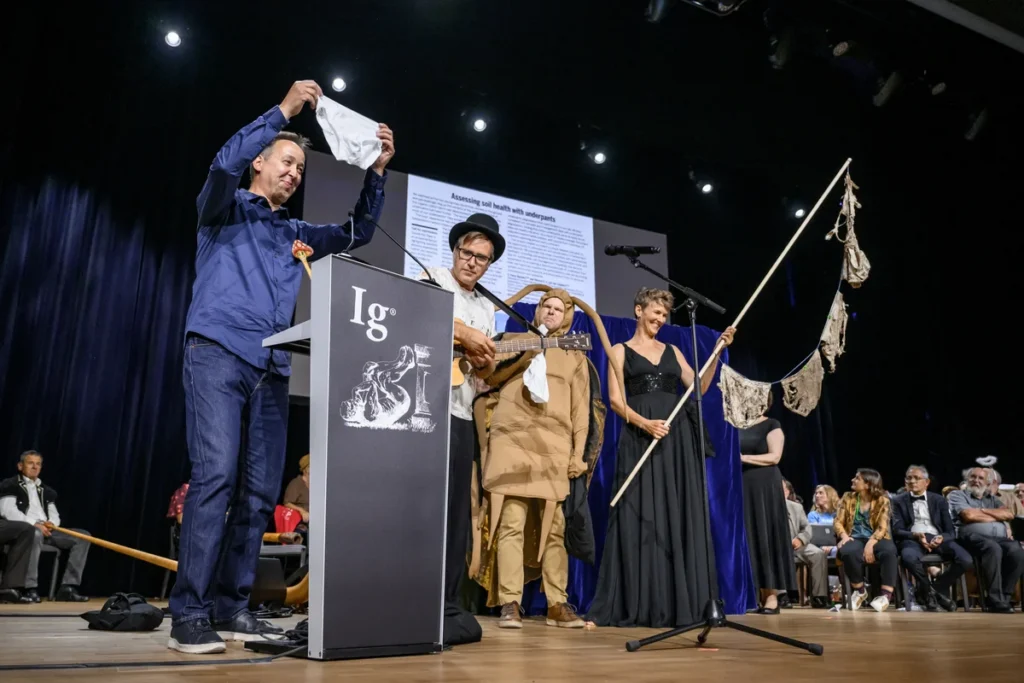
Of the ten awards presented on September 3 in front of 1,500 people, the one most relevant to those concerned with the environment comes from the “soil science” category. A group of Swiss and Dutch researchers buried 1,000 identical pairs of organic cotton underwear in more than 25 countries, then dug them up two months later. The project, which began as a citizen science initiative, demonstrated that the rate at which the fabric decomposes is an economical and reliable indicator of biological activity in the soil: where bacteria, fungi, and earthworms are most active, only the elastic band remains of the underwear.
It is a method that any farmer or school can replicate without expensive laboratories, which is why the study, published in *Science*, has already inspired similar environmental monitoring efforts in several European countries.
Physics, Mosquitoes, and Vipers: The List of Winners
The rest of the list of winners confirms the essence of the event: genuine research—often published in top-tier peer-reviewed journals—applied to seemingly trivial questions. The physics prize went to a group of North American and Asian universities that designed urinals with a geometry calculated to eliminate splatter, incidentally discovering why dogs urinate on trees at very sharp angles.
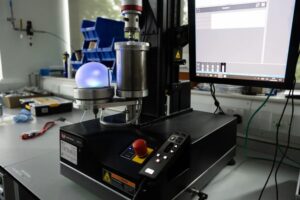
Two researchers from McGill University won the technology award for transforming the proboscis of female mosquitoes into ultra-high-resolution 3D printing nozzles capable of producing lines as thin as 20 microns. The biology prize was awarded to a Brazilian team that gently stepped on dozens of Bothrops jararaca snakes—a species responsible for about 20,000 snakebites a year in Brazil—to understand what triggers their bite.
When Laughter Helps Us Understand
The format has remained the same for 36 years: paper airplanes thrown onto the stage, speeches limited to 24 seconds and then to just seven words, and the presence of actual Nobel laureates serving as a chorus. Behind the surreal stage design lies a principle often overlooked by those involved in environmental communication: the most useful data doesn’t always come from solemn questions. Measuring soil with underwear works precisely because it’s understandable, replicable, and memorable.
The organizers have already announced that Zurich will host the ceremony every two years, while the odd-numbered editions will be held in different cities: the next stop, in 2027, will be Antwerp.