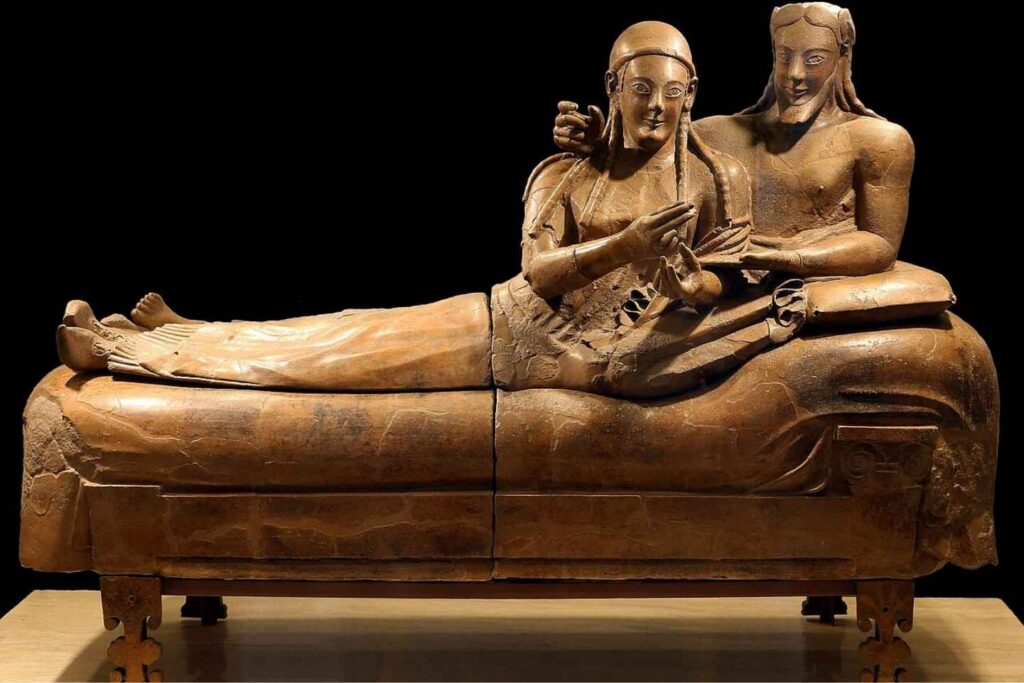
Lying side by side on a communal bed, with him draping an arm around her shoulders, both wearing the slightest of smiles, as if the banquet had never ended. For over 2,500 years, the Cerveteri Couple has been the most famous image of Etruscan civilization, and now their painted surface is once again legible. At the National Etruscan Museum of Villa Giulia in Rome, the restoration project—which kept technicians and conservators busy for more than a year and a half—was completed on October 29.
A portrait of a couple from 25 centuries ago
Carved between 530 and 520 B.C. by anonymous artisans—most likely working in Cerveteri— the sarcophagus measures approximately 2 meters in length and 1.40 meters in height. Husband and wife appear together, on the same plane, during a festive moment: a scene that reveals much about the social customs of the Etruscans and the place reserved for women, and it is precisely this domestic intimacy that has made it famous far beyond the circle of archaeologists. Over time, the couple has become the very symbol of the Roman museum, reproduced on posters, schoolbooks, and postcards.
Dust, cracks, and old paint
No one had touched it for decades. Time had left a layer of dust and encrustations on the terracotta, while the substances used in the past to protect it had degraded. The conservators stabilized cracks and damage to the material and inspected, one by one, the joints and support structures left over from previous interventions, thereby safeguarding the work for years to come. Work began in 2025: during the first four months, from March to June, the focus was on a section of the lid.
The construction site has become a visitor attraction
What makes this project unique is that the workshop was never hidden from view. Anyone entering the museum could stop to watch the technicians, ask questions, or simply observe the pair from an unusual distance. This decision brought to light work that is usually confined behind the scenes, bringing visitors closer to the essence of the artwork. According to Villa Giulia, hundreds of people passed through the space, and the dialogue with the public about the restoration decisions was one of the most successful aspects of the experience.
The Team and Funding
The Central Institute for Restoration (ICR), the Re.Co Consortium, and the company Equilibrarte collaborated with the Museum on this project. The final cost came to 328,000 euros, paid through the Art Bonus—a tax incentive for those who fund heritage preservation—with Banca Popolare del Cassinate serving as the patron. In just a few days, *The Bride and Groom* will once again be on display in their gallery.