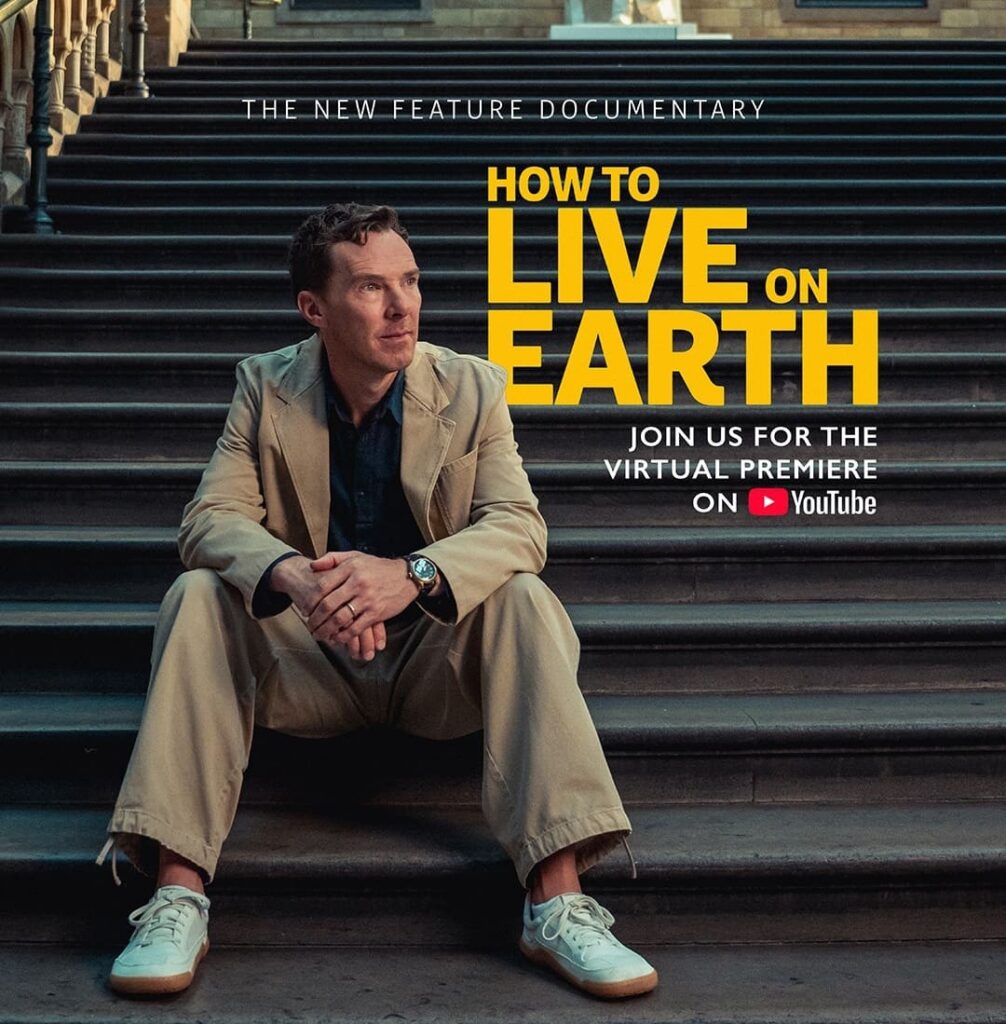
According to a report co-authored by the Met Office, the unusually high temperatures this summer contributed to 2,700 excess deaths in England and Wales. Just as the heat wave was hitting the United Kingdom, Benedict Cumberbatch was promoting his new climate documentary,“How to Live on Earth,”directed by Jonnie Hughes and available for free on YouTube starting September 20. The film is built around a specific idea: to showcase people around the world who are already finding solutions.
The Format of Hope
Filmed largely at the Natural History Museum in London, the film alternates between the actor’s monologues and stories from activists, biologists, and chefs who are experimenting with ways to live in harmony with nature, from soil regeneration to alternative proteins. Cumberbatch speaks as, outside his London hotel, summer temperatures have contributed—according to a report co-authored by the Met Office—to 2,700 excess deaths in England and Wales: “We are living through the effects of climate collapse, so stepping outside is, literally, a call to action,” he told The Guardian.
Buying Nature to Save It
The most interesting part concerns a specific economic idea: treating living nature as a more profitable asset than exploited nature. “An elephant’s tusk isn’t worth as much as the living elephant, because of what it brings to the savanna to keep it functioning as an ecosystem,” the actor explained to the British newspaper, envisioning mechanisms that would compensate for services that have been free until now. It’s the same principle—under different names—as carbon credits and biodiversity bonds: instruments that have attracted capital but that various investigations have shown to be vulnerable to overestimates of environmental benefits and to conflicts with communities in “monetized” areas. Turning an ecosystem into a shareholder in itself does not shield it from the extractive logic it seeks to correct.
The documentary also gives a voice to those who work away from the spotlight: biologist Dan O’Neill, who studies big cats in the rainforests, points out that online distribution allows the film to reach even the communities living alongside the animals featured—communities that are often excluded from traditional film distribution channels.