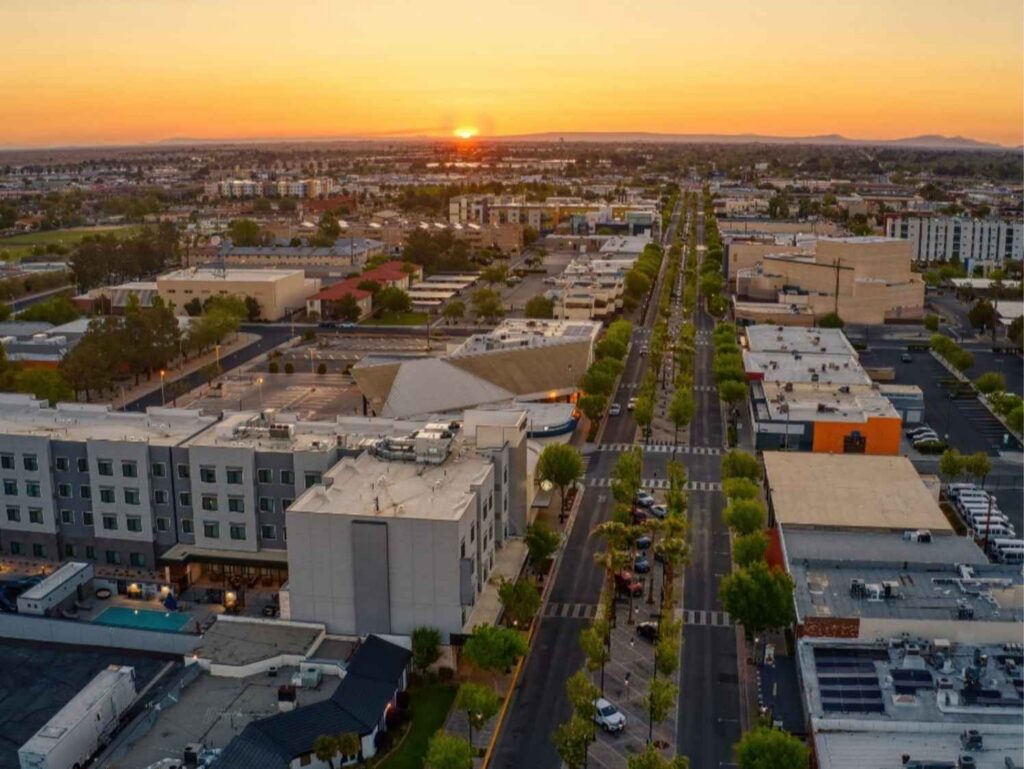
Sixteen years after reducing the space allocated to cars to make room for trees, pedestrians, and businesses, the California city of Lancaster can take stock of its urban transformation. In 2010, this city in the Mojave Desert, north of Los Angeles, converted a five-lane street into a tree-lined boulevard featuring shops, restaurants, museums, and spaces for strolling. This decision helped revitalize the city center, attracting investment and giving residents a place to gather once again.
The redevelopment covers nine blocks of West Lancaster Boulevard, now known as BLVD. As The Guardian reports, the area is home to about 250 public and private businesses, making it a hub for residents and merchants.
A Road Turned into an Investment
To revitalize the city center, the Lancaster administration has invested $11.5 million. The three central lanes of the old street have been replaced by tree-lined boulevards, modeled after the Spanish ramblas, which provide space for pedestrians and public life. The goal was to make the downtown area more accessible and vibrant, thereby encouraging the presence of businesses and services. The economic results were quick to follow.
According to city government data, as reported by the Congress for the New Urbanism, in the four years following the completion of the project, it generated over $270 million in economic activity and attracted $130 million in investments. It also contributed to the creation of hundreds of jobs and the construction or renovation of numerous homes.
The Library That Has Regained Its Readers
The change is also evident in everyday life. John Elford, director of the public library, recalls that during construction, many residents protested the reduction in space allocated for cars. After the opening, he told the British newspaper, the complaints stopped.
The new street has brought people to the library who didn’t visit it before. Visitors have started staying longer, reading, and using the spaces as a place to meet. Shop owners also describe a more vibrant neighborhood. Nicole Stevens, owner of a craft store, points out how the redevelopment has brought small businesses and families closer together. The ability to get around easily on foot has fostered new relationships among residents, customers, and shop owners.
The BLVD Association was also founded in 2013; it is an organization that brings together property owners and businesses to collaborate with the city government in managing and promoting the area.
A Lesson for Italian Cities as Well
Lancaster’s experience offers interesting insights for Italian cities, where traffic and a scarcity of public spaces continue to affect the quality of urban life. Reducing the number of traffic lanes has allowed the American city to reclaim space for trees, pedestrians, and economic activities, without consuming new land.
Sixteen years after its redevelopment, the boulevard still hosts markets, cultural events, and commercial activities. This outcome demonstrates how revitalizing existing streets can help revitalize urban centers while simultaneously improving accessibility and economic opportunities.