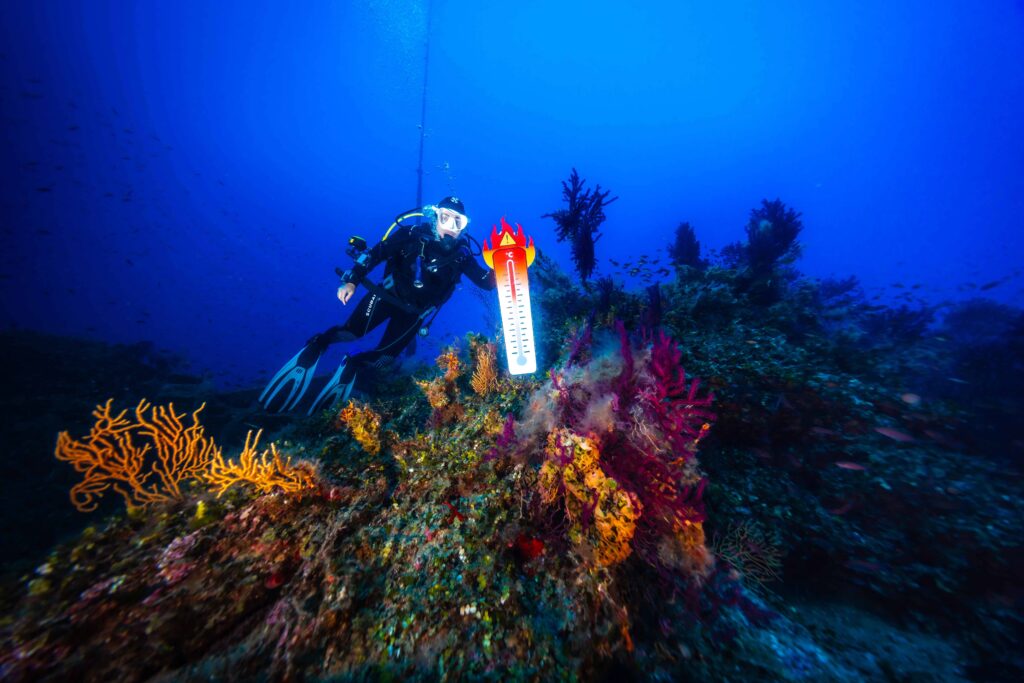
The heat is no longer confined to the surface. This is the message of the“Mare Caldo” report, through which Greenpeace has been monitoring the health of the seabed since 2019 in collaboration with DISTAV at the University of Genoa, OGS, and the University of Urbino. The 2025 data come from fourteen stations distributed along the coast, thirteen of which are located within Marine Protected Areas.
Copernicus notes that 2025 was the third-warmest year on record globally, with an anomaly of 1.48 degrees compared to the pre-industrial era. In the Mediterranean, some areas experienced more than 200 days of marine heatwaves and surface temperatures up to 2.5 degrees above average. But the most concerning finding is another: the heat has penetrated deep into the water, and underwater thermometers have detected it at depths of up to 40 meters.
Sardinia and Sicily are the hardest-hit areas
The highest surface anomaly—3.5 degrees above the threshold—was recorded in Sardinia, on Asinara, during a 41-day heat wave between late May and July. The values at Capo Carbonara and Tavolara were close behind (3.46 degrees), while in Sicily, Capo Milazzo (2.94) and the Plemmirio (2.71) stood out. Driven by winds that churn the water column, the heat accumulated over the summer penetrated downward: at depths of 30–40 meters, temperatures reached 25 degrees, a level that causes severe stress for organisms clinging to the rocks.
Gorgonians and Corals Under Stress
Biological monitoring conducted on the Island of Elba, Asinara, and Torre Guaceto reveals what all of this means for marine life. Signs of necrosis or bleaching have appeared everywhere among the most fragile species, such as the yellow gorgonian Eunicella cavolini and the coral Cladocoracaespitosa. Meanwhile, organisms that thrive in warm waters are spreading, including the invasive algae Caulerpa cylindracea. Environmental DNA analysis—which identifies species based on genetic traces left in the water—has revealed additional invasive species invisible to the naked eye, ranging from Sargassum thunbergii to Phallusia nigra.
The loudest alarm bell is ringing on Elba Island, the only station in the network without protection. Here, a comparison of six years of data shows a steady decline: shrinking colonies, increasingly stressed organisms, and gorgonians such as Eunicella cavolini and Paramuricea clavata in obvious distress. Researchers attribute this decline to the persistent temperature anomalies recorded in 2023 and 2024.
Protected areas are not enough
The data confirm that Marine Protected Areas help ecosystems withstand stress, but no area is safe anymore. Temperature anomalies, explains Valentina Di Miccoli, Greenpeace Italy’s Marine Campaigner, are now reaching even the deepest habitats and affecting the health of the ocean even in protected areas: protection alone is not enough; a drastic reduction in greenhouse gas emissions is needed.