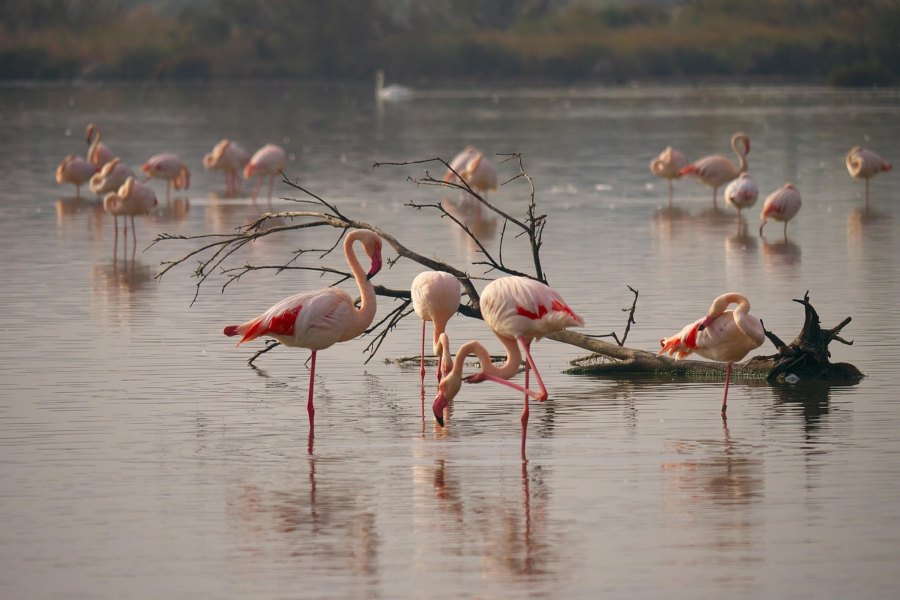
Today, the geography of the lagoon is being redrawn away from St. Mark’s Square, among salt marshes, velme (the muddy bottoms that surface only at low tide) and fishing valleys, the fenced basins used for aquaculture. It is here that the massive presence of flamingos is changing the face of the landscape.
The latest ornithological monitoring data describe a vertical growth: wintering specimens in 2025 touched 24 thousand. An absolute record that rightfully places the Venetian lagoon among the most important wintering areas in Europe for this species.
The phenomenon is a recent one. The first significant observations date back to the early 2000s. The novelty is such that the Venetian dialect, historically encyclopedic about the local environment, does not even have a specific word for these birds.
The push of tides and fishing valleys
The increase in the flamingo population has specific reasons: abundant food and the play of the tides. The continuous movement of water allows the birds to exploit different areas throughout the day, turning the lagoon into an always-available larder. A key role is played precisely by the fishing valleys, semi-natural systems perfect for stopping and recovering energy during the winter. While until now the bulk of the population has been concentrated in the northern lagoon, flows are now changing direction.
The south lagoon bet
Venice’s environmental heritage remains in check, however. Of the 550 square kilometers of the lagoon, brackish wetlands once occupied nearly half the surface area. Today, just 7 percent remains. Between industrial canal excavations and river detour, human intervention has accelerated the loss of sediment, breaking an age-old balance.
The answer to this decline is called WaterLANDS, a more than 20 million euro European project funded by the Horizon 2020 program. In the southern lagoon, the area most affected by degradation and erosion, technicians are physically reconstructing salt marshes. The plan involves relocating local sediments and planting native species to consolidate the land, creating natural barriers capable of dampening the force of waves. The data collected in the field serve to show that the degradation process can be stopped, preventing the lagoon from permanently turning into a barren sea bay.
Tourism outside the clichés
Biodiversity yards are working. In addition to curbing erosion and absorbing carbon, the new salt marshes are attracting wildlife: in the southern lagoon, flamingos have gone from a few isolated sightings to flocks of 300-400. They now aim for stable nesting, after failed attempts in 2008 and 2013.
The return of flamingos reshapes the identity of a Venice choked by mass tourism, shifting the spotlight to the survival of its ecosystem. Spotting them is not a one-shot bet: you need a boat, patience, and respect for the lagoon’s timing. But that pink spot gaining ground on the horizon reminds us that if humans step back and protect habitats, nature will take back the space that belongs to it.