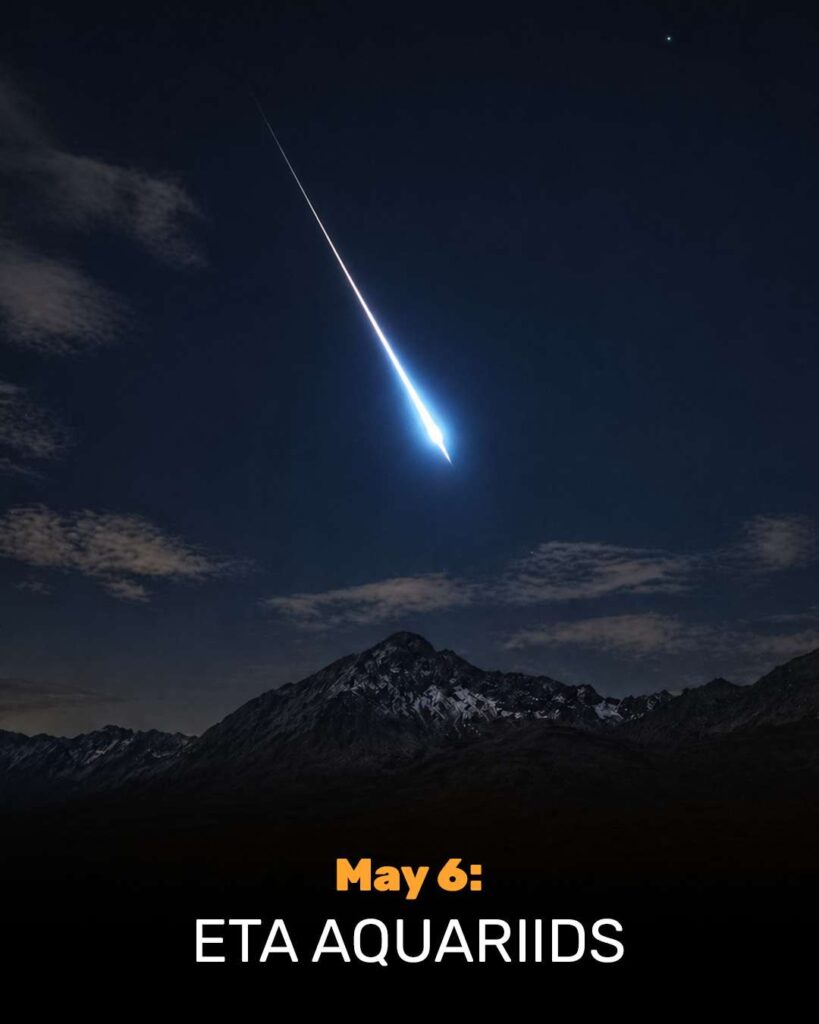
Every year, between late April and early May, Earth passes through the debris trail left by Halley’s Comet. The result is one of the fastest and most abundant meteor showers of the year: the Eta Aquarids. It peaks on the night of May 5-6, between 4 a.m. and 5 a.m. This year there is one obstacle, the nearly full Moon, but the spectacle is still worth the early wake-up call.
What are Eta Aquaridae
Eta Aquarids meteors are comet fragments-dust and ice compacted over time-that enter Earth’s atmosphere at about 66 kilometers per second, or more than 237,000 kilometers per hour. At that speed, the friction with atmospheric gases is enough to bring them to incandescence in fractions of a second, producing those white or colored trails that cross the field of vision before the brain has time to register them properly.
The Eta Aquarids are among the most generous meteor showers of the first half of the year: according to theInternational Meteor Organization, under ideal conditions they produce up to 50 meteors per hour, two to three times more than the October Orionids, which also share the same parent comet. A not insignificant detail: this swarm is known for persistent trails, bright streaks that remain visible in the sky for a few seconds after the meteor passes, like a mark left in the air.
Why are they called that
The name follows a precise astronomical logic. “Aquarids” because their radiant-the point in the sky from which the trails appear to come, for a perspective effect similar to that perceived by driving under snow-is in the constellation Aquarius. “Eta” because that point is close to the star η Aquarii, the seventh brightest in the constellation according to Greek classification. The distinction is important: in July the same constellation is home to the Delta Aquarii, another swarm, but one of completely different origin.
The “Earth-grazers“
For those observing from Italy, the position of the radiant relative to the horizon creates conditions for a particularly spectacular phenomenon: the so-called Earth-grazers, meteors that skim the upper layers of the atmosphere almost horizontally. Instead of a short, vertical trail, they produce very long trajectories that seem to travel across the entire sky from side to side, often with changing colors, before fading away. They are rarer than ordinary meteors, but when seen, they are hard to forget.
When to look and where
The peak is on the night of May 5-6, 2026, but the nights between May 4 and 7 are all valid. Time matters: before midnight it is practically useless to go out, the radiant is too low. The best window is between 4:00 and 5:00 am, when the constellation Aquarius will be high enough on the east-southeast horizon. Around 5:30 a.m. the sky begins to clear for the Sunrise, and the show closes.
The right direction is east/southeast, keeping the gaze about 30-40 degrees above the horizon. Telescopes or binoculars are not needed; on the contrary, they would unnecessarily narrow the field of view. Meteors are observed with the naked eye, aiming to encompass the widest possible portion of the sky.
The “problem” of this 2026 edition: the moon
The full moon fell on May 1, so on the night of the peak we will have a waning gibbous Moon with an illumination around 84%: very bright, and with a habit of rising just in the second part of the night, not far from the radiant of the swarm. Under these conditions, the fainter meteors are “buried” by the lunar flare, and the sighting rate may drop below 10 meteors per hour compared to the normal average of 10-30.
The solution is to position yourself where a physical obstacle-a building, a hill, a row of trees-physically hides the lunar disk from view. This will recover some contrast in the sky, and even with the Moon partially shielded the brightest meteors and persistent trails remain clearly visible.
How to prepare
Finding a dark place is the priority: away from artificial city lights, with an unobstructed east-southeast horizon. Once at the location, it takes at least 20-30 minutes for the eyes to adjust to the darkness, a real physiological process, not an exaggeration. A smartphone on at that juncture resets everything: the light from the screen is enough to impair night vision in seconds. Dressing warm is more important than it sounds: the hours between 3 and 5 a.m. in early May can be chilly, and prolonged immobility doesn’t help. A towel to lie on to look up is more comfortable than any other position.
Halley’s Comet we won’t see it until 2061. But tonight, clouds permitting, we may encounter something of its own.