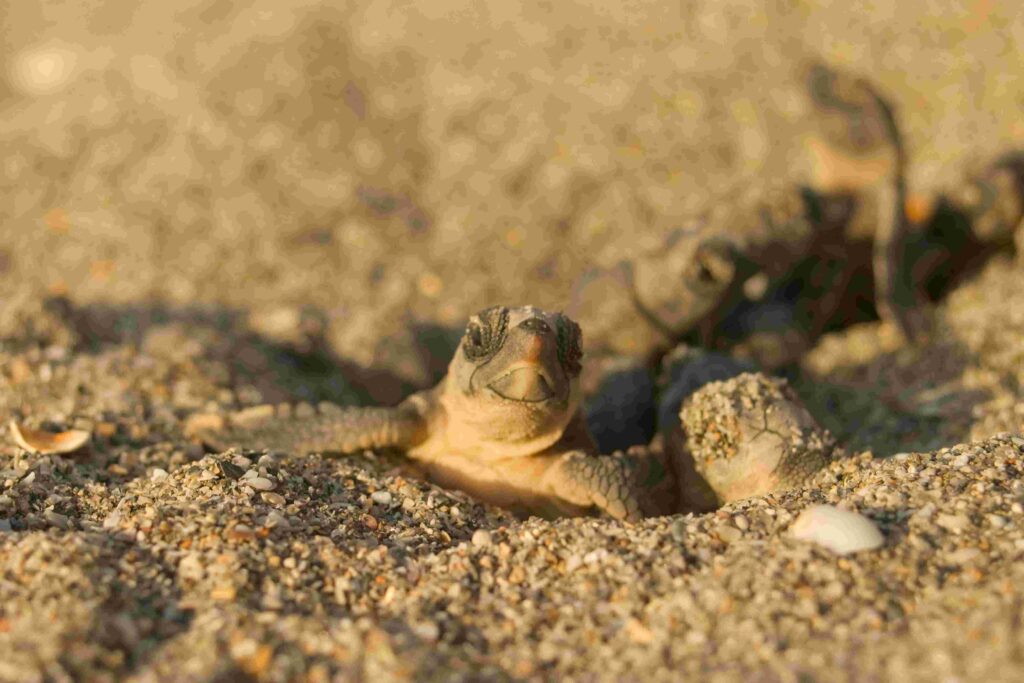
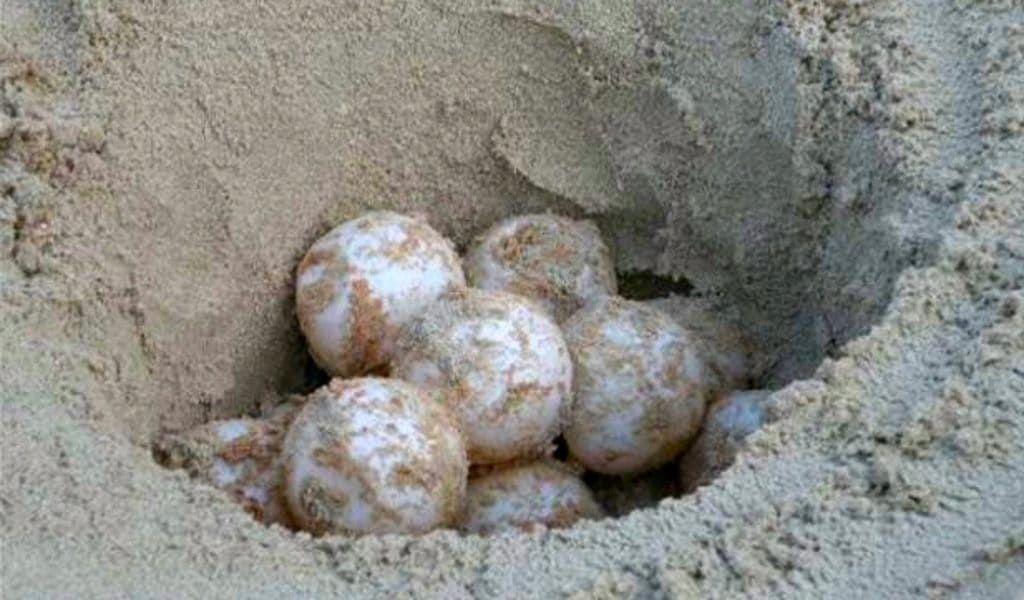
In Ripe Rosse, in the Cilento region, a small area marked off by stakes and netting indicates the spot where, just a few centimeters beneath the sand, a female Caretta caretta — the most common sea turtle species in the Mediterranean— laid about a hundred eggs a few weeks earlier. A little further on, there are two more such spots, each with a sign bearing a date and an identification number. There is nothing to see, strictly speaking: sand, a flimsy fence, the relentless July heat. And yet, that seemingly empty expanse conceals life that stubbornly continues beneath the surface, often indifferent to those walking above it.
It is a landscape that requires one to learn to read almost invisible signs, like a trail left behind in the night. It is on these details that part of the species’ conservation hinges today.
In recent years, the Cilento region has become one of the most important nesting areas for the loggerhead sea turtle (Caretta caretta) in the western Mediterranean. In Italy, the number of nests recorded rose from 443 in 2023 to over 700 in 2025, with nesting sites now extending as far as Liguria. This is one of the signs of a changing Mediterranean: as the sea warms, the turtles are altering their migration routes, and new beaches are becoming nesting sites.
The work is coordinated by LIFE Turtlenest, a European project led by Legambiente in collaboration with researchers, public agencies, and volunteers who, along nearly 8,000 kilometers of coastline spanning Italy, France, and Spain, are working to increase the chances that a turtle will still find its way to the sea.
Sandra Hochscheid and the Concept of Resilience
Sandra Hochscheid, coordinator of the Turtle Point Sea Turtle Research Center at the Anton Dohrn Zoological Station, explains the more scientific side of the project to me. She has been studying sea turtles for nearly thirty years. As a child, she would lose herself in Jacques Cousteau’s documentaries and dream of becoming a veterinarian. At the time, however, someone told her that it wasn’t a profession for women. She chose a different path and has never looked back.
When asked what continues to amaze her about these animals, she doesn’t hesitate for even a second. “Their incredible ability to adapt to their environment. When I think of turtles, I think of resilience.”
It’s a word that comes up often in conversation. It also helps explain what’s happening in the Mediterranean today. Hochscheid uses a technical term,“philopatry relaxation”: in other words, the females seem to have become less rigid in choosing where to lay their eggs, moving away more easily from the beach where they were born. This behavior could explain why the species is colonizing new coastlines.
A study published in *Nature*, based on genetic analyses of nests found on the Spanish coast between 2016 and 2019, suggests that these new nesting sites do not belong to local populations, but rather to females originating from the Atlantic or the eastern Mediterranean.
The Consequences of Climate Change
Sandra Hochscheid, on the other hand, is more cautious when it comes to the consequences of climate change. Higher temperatures favor the birth of females, altering the sex ratio. “If the balance shifts toward females, that could certainly be a problem. But no one has ever studied an ongoing colonization process. We can’t predict what will happen.”
Among the research areas being explored this year is the analysis of eggs that fail to hatch, to determine whether the problem lies in fertilization or in embryonic development.
Every morning, Hochscheid explains, work begins before dawn. By 6:00 a.m., volunteers are combing the beaches in search of the tracks left by the females during the night, before the wind or people passing by erase them. Today, on-foot monitoring is supplemented by drones, which allow researchers to cover stretches of coastline much more quickly.
When a nest is found, the team decides whether to leave it where it is or move it to a “hatchery”—a protected area used when the beach is too exposed to vehicle traffic, artificial lighting, or predators. A data logger is also placed in the sand to record the temperature, allowing the team to estimate the hatching date with a margin of error of about two days.
The success rate is around 75%, in line with the rest of the Mediterranean. Each female lays an average of about 100 eggs per nest and may return to the same coastline every 11 to 14 days, up to five times in the same season.
The Tartadog’s Nose
Among the innovations of LIFE Turtlenest are the “Tartadogs,” canine units trained to locate nests hidden beneath the sand. After the eggs are laid, the wind and people walking by quickly erase the traces left by the female. When this happens, the dogs’ sense of smell can make all the difference.
At dawn, during a demonstration on the beach, Brum Brum—a tireless and enthusiastic two-year-old Springer Spaniel—moves forward with her nose pressed against the sand. She’s wearing a clear mask to protect her eyes while she works. She moves quickly, stops, then starts again. Then, suddenly, she freezes. That’s the signal. There might be a nest right there.

“The dog helps support the monitoring carried out by volunteers and technological tools,” explains Serena Donnini, a trainer with the Italian National Dog Breeding Association. “The training takes a long time because we work with buried scents.”
The goal is to take action when visible clues have already disappeared. The project’s K-9 units, located throughout northern, central, and southern Italy, can respond to any report within forty-eight hours.
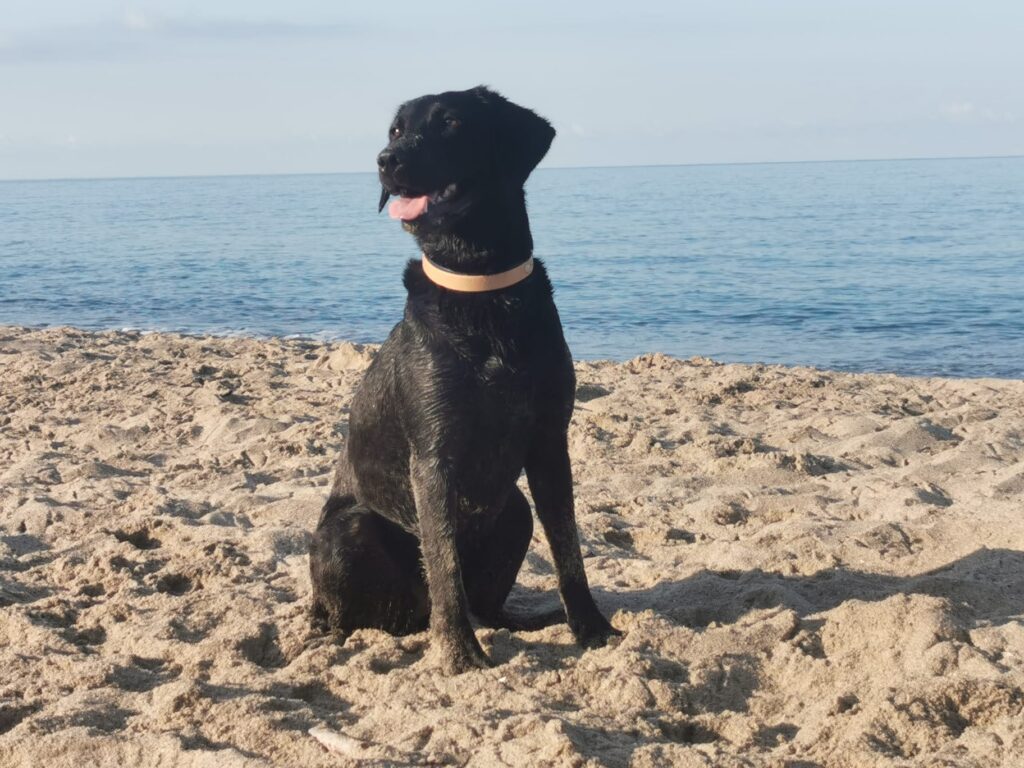
Chiara Comes’s story follows a similar path. She is thirty-two years old, lives in Bari, and joined the project this year along with her two-and-a-half-year-old Labrador, Rebi. She chose her, she says, “simply to get some exercise,” before discovering that the dog had a special talent.
Rebi also signals a find by stopping suddenly. Trainers call this behavior “freezing”: the dog picks up the scent and remains perfectly still. “It’s essential that the signal be passive. The dog must never come into contact with the eggs.”
For Chiara, this work is in addition to her daily activities at a dog training center. I ask her what motivates her to devote her free time and weekends to this experience. She smiles. “I can see that you’re having fun, and I’m having fun, too. At the end of the day, it’s just a game.”
In reality, it’s much more than that. If a nest is spotted in time, it can be protected with a fence or, in the most delicate cases, safely relocated. It’s one of those tasks that visitors hardly ever notice, but it can make the difference between a successful hatch and a lost brood.
Walking in the Dark
In the evening, in Ascea Marina, after searching for what lies hidden beneath the sand, the project focuses on artificial light.
For a newborn turtle, the direction of the sea is not obvious. The hatchlings generally emerge at night and navigate by following the natural glow of the horizon. A lit road, a streetlight that’s too close, or a white light shining on the beach can confuse them and lead them in the wrong direction. With the outcome we can all imagine.
This is where the work of Chiara Carucci, a lighting designer, comes in; she collaborated with the Municipality of Ascea to design the new coastal lighting system.
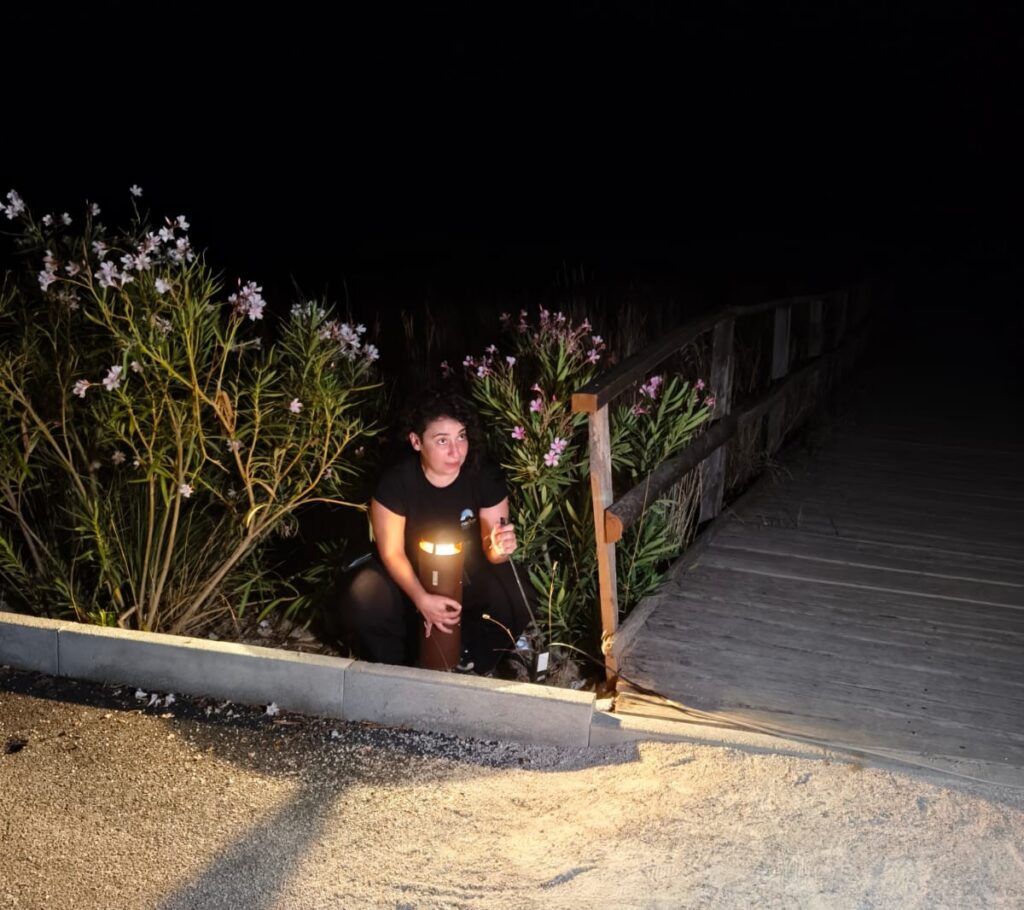
A few years ago, a survey conducted among tourists on the Campania coast showed just how rare it had become to experience natural darkness. Carucci calls this a form of environmental amnesia: we get used to living constantly surrounded by light and end up forgetting that darkness, too, is a part of the environment.
That is why the new streetlights are shorter—between three and four meters instead of the previous seven—and use a warmer light with a color rendering that more closely matches natural light.
The project, donated by the LIFE Turtlenest project to the Municipality of Ascea under a five-year maintenance agreement, includes 82 light fixtures, each 50 centimeters tall, along the pedestrian path next to the bike trail in the Cilento National Park. At Bahia Beach, the change is immediately noticeable. The section that has already been upgraded uses diffused, horizontal lighting, which is sufficient to illuminate the path without causing glare.
A Beach That’s Learning to Change
Turtle conservation also depends on local governments and new habits. More than 130 municipalities have joined the “Turtle-Friendly Municipalities” protocol promoted by Legambiente. More than 4,000 lifeguards have been trained in just over two years to recognize the tracks left by female turtles on the beach and report any nesting activity.
Among them is Stefano Sansone, mayor of Ascea Marina and president of the Cilento, Vallo di Diano, and Alburni National Park Community. The territory he represents comprises eighty municipalities under a single governing body, and in recent years it has also begun to rethink the way beaches are managed. One of the initiatives concerns beach cleaning: mechanical cleaning will soon be phased out in favor of manual cleaning. “Our beach may return to the way it was fifty years ago.” This statement conveys a certain vision of the future: restoring some of the conditions that once allowed nature to thrive.
All the work we’ve seen over these two days—from dawn monitoring to drone flights, from dogs to data loggers, from redesigned lighting to agreements with municipalities—is aimed at protecting an ancient instinct: the one that, at the moment of hatching, leads the hatchlings in a single direction. The sea.