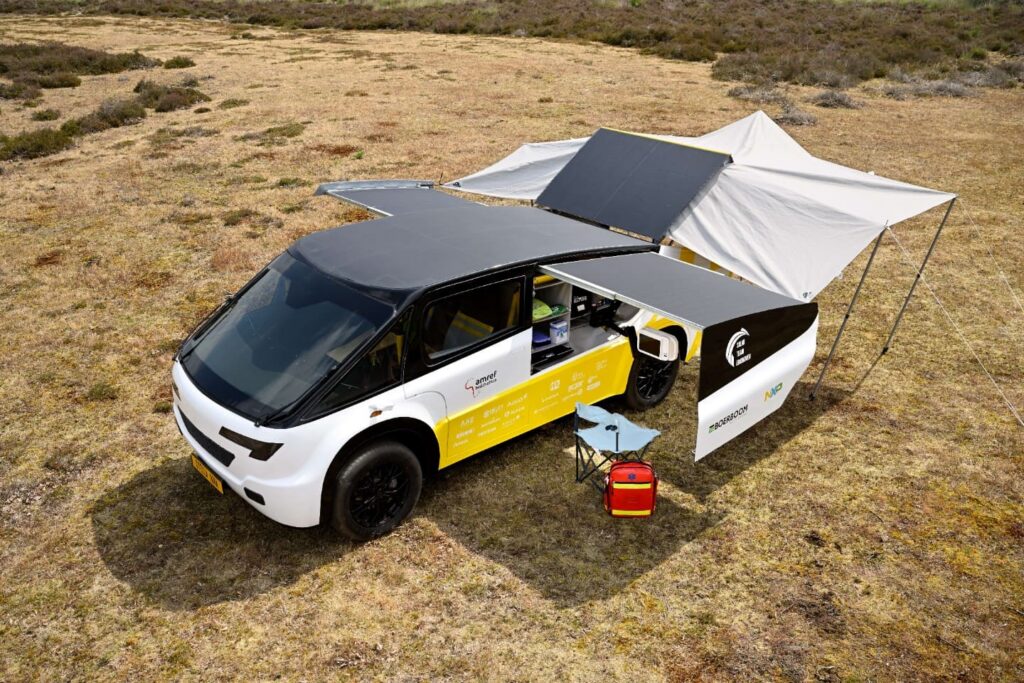
It’s called Stella Juva, and it’s the first solar-powered ambulance developed by students on the Solar Team at the Technische Universiteit Eindhoven (TU Eindhoven), a Dutch technical university specializing in engineering and innovation.
In August, it will be tested in Kenya, where it will need to demonstrate the effectiveness of a healthcare model designed to reach the most remote areas with diagnostic tools and equipment powered exclusively by solar energy. The project’s goal is to address one of the main obstacles to healthcare in many rural areas of Africa: the difficulty of reaching hospitals and clinics due to poor roads, a lack of electrical infrastructure, and limited fuel availability.
In these contexts, having access to an energy-independent vehicle can make all the difference in prevention and early diagnosis.
A solar-powered mobile clinic
More than just a traditional emergency vehicle, Stella Juva is a mobile medical unit. The energy generated by the solar panels installed on the roof powers both the engine and the medical equipment on board. According to the designers, on a sunny day the vehicle can travel up to 715 kilometers, operating without relying on the power grid or refueling stations.
Healthcare workers will be able to perform blood tests, tuberculosis and malaria screenings, vaccinations, and obstetric ultrasounds directly in the villages, sparing many patients long and difficult trips to hospitals.
The field test in Kenya
To develop the project, Solar Team Eindhoven partnered with Amref Health Africa, an organization that has been working for decades to strengthen African health care systems. “For millions of people, good healthcare remains a distant dream. Access to care should not depend on the availability of electricity or fuel,” says Femke Maurits, head of partnerships for Amref Health Africa in the Netherlands. “In the most remote areas, healthcare workers travel enormous distances by bicycle, and electricity is never a given—even though it’s essential for storing vaccines and operating medical equipment.”
In August, the team will travel hundreds of kilometers using only solar power, testing the vehicle’s reliability under the conditions for which it was designed.
Technology and Real Needs
“We were inspired by the United Nations’ Sustainable Development Goals, which aim to ensure everyone’s right to health,” explains Mathijs van Gerven, team manager of Solar Team Eindhoven. For Yarno Basten, the group’s partnership manager, the project also demonstrates the value of collaboration between universities and the nonprofit sector: “We hope to make access to healthcare not only more widespread but also more sustainable.”
Stella Juva began as a prototype, but it addresses a problem shared by millions of people: the lack of consistent access to basic health care services. In this case, solar energy serves as a tool to expand access to medical care in rural areas, reducing dependence on infrastructure that is often lacking precisely where the need for care is greatest.