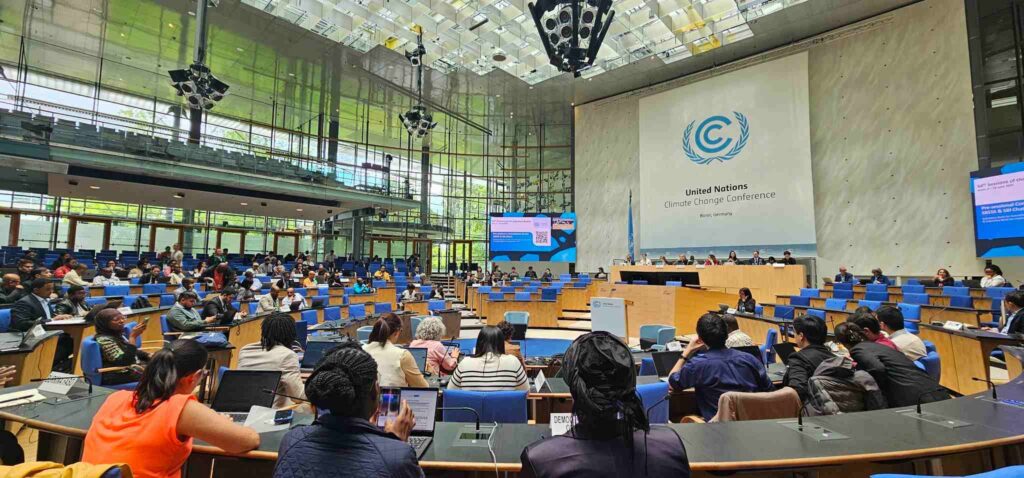
The Bonn Climate Change Conference (SB64 ) opened today at a complex time for climate diplomacy. Negotiations will have to deal with the inadequacy of national plans to cut emissions compared to the Paris targets, a return to the use of fossil fuels for “energy security reasons,” and continuing difficulties in mobilizing promised funding to developing countries.
Until June 18, government delegates, technicians and observers will meet in the German city to untangle these knots and prepare the way for COP31, scheduled for November in Antalya, Turkey. The agenda of the proceedings reflects how closely climate policy is linked to other public policies: while emissions reductions remain at the heart of the discussion, technical tables will continue to grapple with issues of finance, adaptation, just transition, and the impact of environmental regulations on global markets.
When climate becomes economic policy
Among the dossiers being followed most closely is the delicate relationship between trade and climate change, an issue bound to ignite the UNFCCC’s technical dialogues. Green industrial policies adopted by the United States, the European Union and China, along with border carbon adjustment mechanisms, could directly influence global economic balances.
Many emerging and developing countries are likely to contest these measures, viewing them as unilateral protectionist barriers masquerading as environmental regulations. In contrast, advanced economies will defend them as indispensable tools for avoiding emissions offshoring and pushing decarbonization without penalizing their own domestic industries. The confrontation in Bonn could highlight how climate regulations now have geopolitical weight and a direct impact on global trade competitiveness.
From theory to transition
Among the issues on the agenda will be the “just transition,” the pathway out of fossil fuels aimed at protecting workers and communities. Following the COP30 agreement in Belém for a new international mechanism, work will begin in Bonn to operationalize this system, focusing on technical assistance, skills development and cooperation. Social sustainability should remain a key element in determining the real speed of the energy transition.
Adaptation and damage management
Also central will be the issue of adaptation, that is, policies for living with climate impacts that are already underway. In Bonn, work will be done on establishing common indicators to measure countries’ progress in resilience to extreme events, a necessary step in assessing the effectiveness of public investments. In parallel, discussions on “Loss and Damage” will resume. Issues related to the Financial Fund for Climate Emergencies and the Santiago Network (the U.N. platform that sends experts and technical assistance to the field to manage disasters) are expected to be addressed across several negotiating tables, with the goal of making this aid faster and more accessible for the most vulnerable countries.
The node of finance and multilateralism
Many of the discussions will converge on climate finance, historically the main dividing line between developed and developing countries. In Bonn, tools for mobilizing the resources needed to support global climate action will be explored, a confrontation that for years has measured the level of trust between the global North and South.
The technical tables opening in Bonn will be tasked with translating into rules a transition that is at once ecological, industrial and commercial. More than a grand political agreement, the German summit will be a key thermometer of whether climate diplomacy can still withstand the brunt of rising global geopolitical and economic tensions.