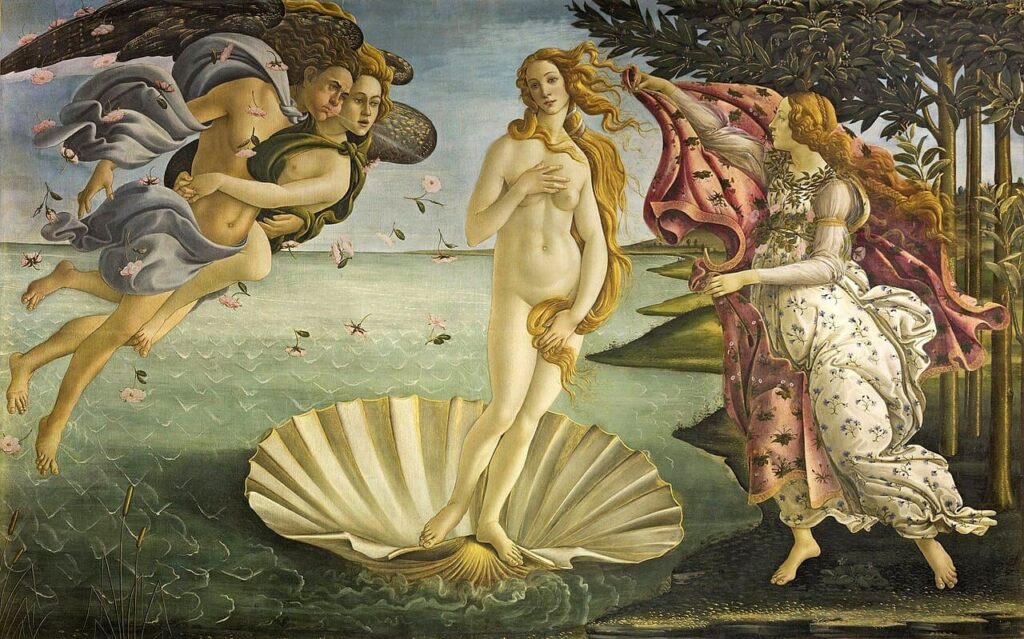
For over five centuries, Simonetta Vespucci has remained the symbol of Renaissance beauty and, at the same time, one of history’s great mysteries. The young noblewoman from Liguria, considered Sandro Botticelli’s muse and identified as the Venus in the famous Birth of Venus, died in 1476 at the age of just 23. The diagnosis handed down through the centuries has always been the same: tuberculosis. Today, however, modern medicine suggests another possibility.
A study published in *Endocrinology,* Diabetes & Metabolism by Domiziana Nardelli, Dennis Black, Anne Schafer, and Paolo Pozzilli suggests that Simonetta died as a result of a pituitary tumor apoplexy, an acute event caused by hemorrhage or infarction of a pituitary adenoma. This is not a certainty, but a hypothesis developed by cross-referencing historical documents with modern clinical knowledge.
Symptoms Reinterpreted Through a Modern Lens
The authors base their account on contemporary news reports. In the last days of her life, Simonetta reportedly suffered from profuse nosebleeds, runny nose, severe headaches, vomiting, fever, confusion, and even hallucinations. Viewed from today’s perspective, these symptoms are consistent with a diagnosis of pituitary apoplexy.
This study builds on a paper published in 2019, in which Pozzilli and colleagues had hypothesized the presence of an adenoma secreting prolactin and growth hormone. Historical and iconographic evidence was cited in support of this hypothesis: the possible galactorrhea depicted in a painting attributed to Botticelli, the absence of children, and certain progressive changes in facial features, which were also analyzed using a facial recognition algorithm.
Hypotheses and Their Limitations
In their new study, the researchers identify three elements supporting their reconstruction: the characteristics of the hypothesized tumor, the consistency of the symptoms described in historical sources, and two possible triggering factors. The first would be mechanical trauma related to Renaissance dances, during one of which Simonetta collapsed after a severe nosebleed. The second refers to an alleged episode of violence recounted in later texts, which could have caused enough physical stress to trigger the acute event.
The authors themselves, however, remain cautious. In the absence of diagnostic tests, they explain, it is not possible to definitively determine the origin of the tumor or rule out alternative diagnoses.
When History Meets Medicine
The value of this study extends beyond the fate of Simonetta Vespucci. It demonstrates how contemporary medicine can reexamine historical cases through the scientific method, without claiming to rewrite history with definitive conclusions. Retrospective diagnoses remain, by their very nature, hypotheses. But when they are based on documents, pathophysiology, and scientific literature, they become a useful tool for better understanding both the past and the evolution of medical knowledge.