On August 26, Italy woke up divided in two. In the North, thunderstorms and unstable weather conditions persist, a remnant of a low-pressure vortex that has brought rain to Veneto, Friuli-Venezia Giulia, and the Alps in recent days. In central and southern Italy, however, the subtropical high-pressure system has never let up. From here, the African high-pressure system will begin to expand again; according to meteorologist Giulio Betti, this expansion will not subside in a few days butwill “affect the South and Sardinia” until September 2.
The Numbers Behind the New Wave
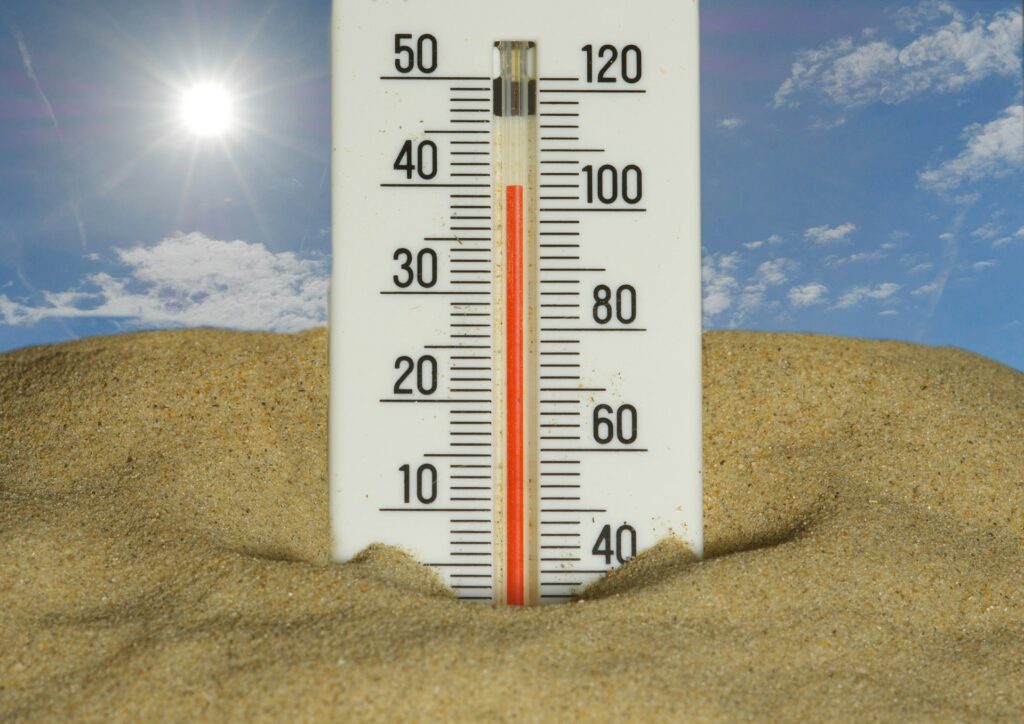
Forecasts from the Italian Meteorological Center indicate temperatures up to 10–12 degrees above average in central and southern Italy, with widespread highs around 40 degrees. On his Instagram profile, Betti predicts the peak will occur “between August 27 and 30,” with temperatures that “will often exceed 40 degrees in Sardinia, Sicily, Calabria, Basilicata, and Puglia,” and peaks reaching “44–45 degrees between Thursday and Saturday in central-southern Sardinia and the inland areas of Sicily, Puglia, and Basilicata.”
The Central and Northern Regions Are Not Left Behind
According to Betti, the heat will spread up the peninsula to affect “the lower Po Valley, Umbria, Tuscany, and Lazio, with highs reaching 37–38 degrees” as early as Friday, a day he describes as “the most challenging.” This figure slightly lowers the highest estimates circulating about Rome and characterizes the heat wave as a phenomenon that is gradually moving northward from the south toward central Italy and the Alpine regions, where the sweltering heat will return.
Scorching nights and Saharan dust
In addition to the highs, Betti points out an often-overlooked factor: the lows. Between Thursday and Saturday, “temperatures approaching 30 degrees are not ruled out in southern Calabria, Sicily, and southern Sardinia.” These are the so-called tropical nights—nights when the body finds no respite even after sunset—which take a particularly heavy toll on the elderly and people with chronic conditions. To complicate matters, “a significant influx of desert dust” is also expected on Friday, linked to the same Atlantic trough that will bring heavy thunderstorms to the Alps while simultaneously drawing subtropical air masses toward the south.
A season of frequent waves
The picture that emerges confirms a now-recurring pattern: intense heat, a brief lull, then another heat wave. The difference this time is in the duration: not a two- or three-day episode, but a phase that, according to Betti’s estimates, will last a full week. For Sicily, Puglia, the Ionian coast of Calabria, and Sardinia, the meteorologist warns, this isn’t even a new event but “the continuation of the abnormal heat wave already underway.”
What remains to be understood
The inland areas of the South—those most exposed to heat waves of 44–45 degrees—also remain the regions with the oldest populations and the most fragile healthcare infrastructure. Forecasts are becoming increasingly accurate in predicting where and how long the heat will last: the open question is who, in those same areas, truly has the means to endure it for an entire week—and not just for a single day of emergency.