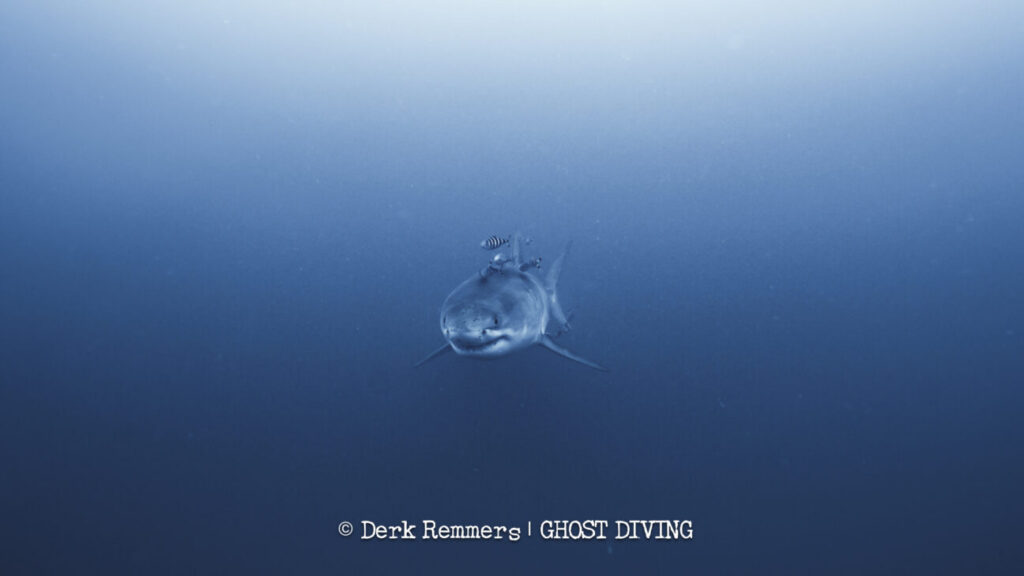
In May, in the deep-sea areaa between Sicily and Tunisia, divers from Ghost Diving-an international network of volunteer technical divers-had descended on a wreck to remove abandoned fishing nets together with researchers from Healthy Seas, a Dutch foundation specializing in the recovery of abandoned fishing gear, and the SDSS (Society for the Documentation of Submerged Sites), which has been studying historic wrecks in the Mediterranean for more than two decades. The goal: to recover ghost nets, the abandoned nets that continue to trap turtles, fish and cetaceans even years after being lost at sea. At one point, in front of the camera of Ghost Diving volunteer Derk Remmers, an adult great white shark appeared.
The images released today are considered the first underwater footage ever taken of a live specimen of Carcharodon carcharias in the Mediterranean Sea in its natural habitat. Sightings on the surface have been there, dead specimens have ended up in fishermen’s nets, but underwater footage in natural conditions did not exist.
What were the divers doing there
The wreck had been monitored before: previous dives had documented Caretta caretta turtles trapped in tangled nets on the structure. Volunteers descended with knives, freed the material, and brought it back to the surface. The shark arrived in the middle. “You spend decades diving on wrecks and removing ghost nets, but nothing prepares you for a moment like this,” Remmers said. “Yet we continued with our dive plan because this encounter clearly demonstrated the importance of our work.”
Critically endangered species
In the Mediterranean, the white shark is classified as a critically endangered species. Populations declined dramatically during the twentieth century as a result of intensive fishing. The distribution of the remaining specimens is largely unknown because almost all the information we have comes from dead specimens. “Most of our knowledge about white sharks in the Mediterranean Sea comes from specimens caught during fishing operations,” explained Carlo Cattano of the Anton Dohrn Zoological Station in Palermo, who is collaborating on the project. “Observations like this are extremely valuable in improving our understanding of the distribution and behavior of this species.”
The Strait of Sicily had already been identified by researchers as a critical area for threatened species. This sighting, according to Cattano, confirms its value in terms of conservation. The mission also included environmental DNA sampling and fauna monitoring-the data will be analyzed in the coming months.
Changing waters
British researchers recently speculated, based on whale fossils with preserved tooth fragments, that white sharks may be returning to the southern North Sea between the United Kingdom, Belgium and Denmark as the waters warm. Unconfirmed sightings are already multiplying along the coasts of Cornwall and northern Scotland. In the Mediterranean, a sea that warms faster than the global average, the consequences for the distribution of pelagic species are still poorly studied.
Since 2013 Healthy Seas has recovered more than 1,300 tons of marine litter worldwide. The ghost nets removed from the Sicilian wreck will not claim any more victims. The shark swimming next to her, for now, is free.