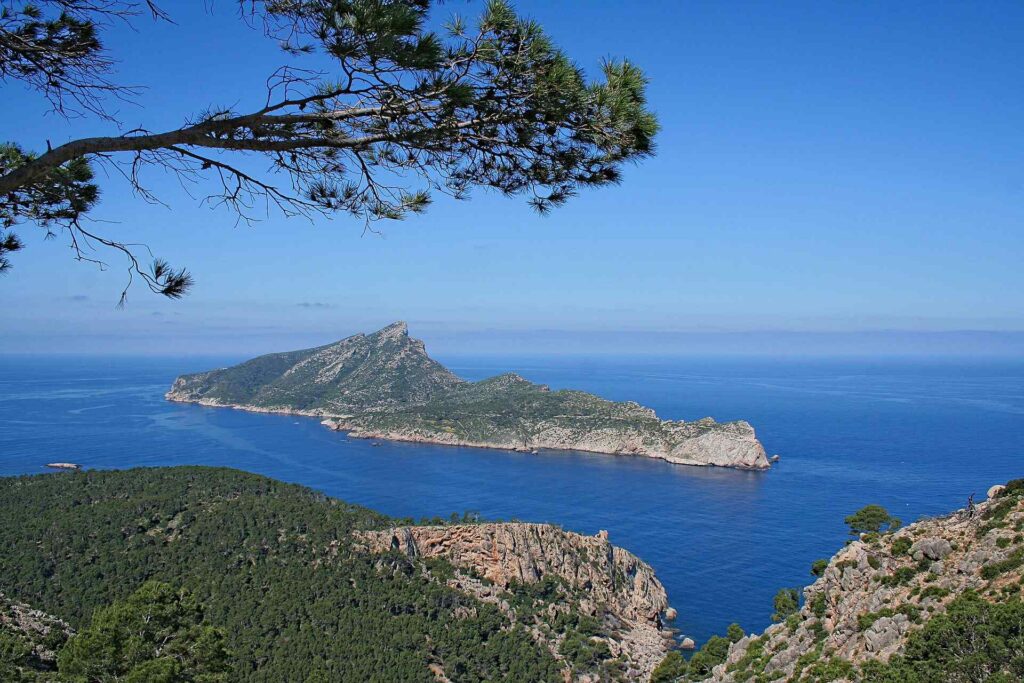
A sea as warm as a heated swimming pool. That’s the picture painted by the reading recorded in early August off the coast of Mallorca, where the buoy at the islet of Sa Dragonera registered a surface temperature of 33.02 degrees. An all-time record for that monitoring station, though it is not an isolated case: according to the Spanish meteorological agency Aemet, the waters of the western Mediterranean are more than 4 degrees above the seasonal average, while in the Cantabrian Sea the deviation is nearly 3 degrees. Satellites from the European Copernicus program confirm this picture and show that the entire body of water surrounding the Balearic Islands is about 2 degrees above the climatic norm.
This isn’t a bolt from the blue. As early as July, the sea around the archipelago had already recorded an average temperature of 28 degrees, nearly 3 degrees above normal: the hottest July on record, accompanied on land by highs of 41.1 degrees in Pollença and a long stretch of sweltering nights.
Marine Heat Waves
The phenomenon isn’t limited to the Spanish coast. Scientists are now referring to marine heatwaves—the underwater equivalent of the heatwaves we experience in cities—which are affecting much of the basin: from the Adriatic, where temperatures exceed 30 degrees, to the Italian seas, which are consistently above average. The same buoy off Sa Dragonera had set the previous record on August 12, 2024, though it peaked at 31.8 degrees: in just over a year, the record has been broken by more than one degree.
The point is that such a warm ocean isn’t just a nuisance for those seeking relief from the heat. It’s a massive reservoir of energy, and sooner or later that energy has to be released somewhere. “Repeated heat waves affect not only air temperatures but also sea temperatures,” meteorologist and science communicator Luca Lombroso explains to LifeGate. “Temperatures in the Adriatic have exceeded 30 degrees, and off the Balearic Islands, they’ve surpassed 33: this is news that should concern us, especially as we look ahead to fall, the season when we’ll pay the price.”
Mediterranean Hurricanes
This phenomenon has a specific name: Medicane, or Mediterranean hurricanes. With water temperatures like these—as Lombroso notes—“we’re above the threshold beyond which hurricanes form.” The basin does not have the geography of the tropics, but the stored energy can transform ordinary weather disturbances into phenomena capable of dumping enormous amounts of rain in just a few hours. Compounding the problem is humidity: a scorching sea releases vapor into the air, preventing it from cooling at night and intensifying the muggy, tropical nights. Along the Romagna coast, ARPAE has measured low temperatures near 25 degrees with 95% humidity; in Alicante, there were twenty nights above 25 degrees in the month of July alone.
The record in the Balearic Islands, after all, is just the latest in a series that has been growing year after year. In August 2024, the water off the coast of Nice had reached nearly 30 degrees; a few weeks later, off the coast of El-Arish, Egypt, it reached 31.96. But the temperature that worries scientists the most is not that of a single stretch of coastline, but rather that of the entire planet.
And on a global scale, too, a record has just been broken. The average daily ocean surface temperature reached its highest level on record: 21.1 degrees on August 22, just above the previous high of 21.09 degrees set in March 2024. This was confirmed by the Copernicus Climate Change Service (C3S), which draws on the ERA5 database, established in 1979. One detail makes this figure even more significant: ocean waters are typically warmest between March and April, at the end of the Southern Hemisphere summer, whereas this time the record was set in the middle of the Northern Hemisphere summer, surpassing even the previous August peak of 20.98 degrees set in 2023.
The Consequences
The consequences of a warmer ocean, warns the C3S, go far beyond the discomfort of a bath at soup-like temperatures. The thermal expansion of water contributes to rising sea levels, multiplying the dangers for coastal communities and low-lying island nations. Marine heatwaves—which are becoming more frequent and intense— are crippling critical ecosystems such as coral reefs and seagrass beds, with repercussions for marine food webs and sectors such as fisheries and aquaculture. There is also a less visible but insidious effect: an ocean that is too warm absorbs less carbon dioxide, weakening one of the planet’s most important natural defenses against the climate crisis.
Behind all these numbers lies an ecosystem that is suffering—and, at the same time, a clear responsibility. It is the price, as Lombroso points out, “of all these years of inaction on climate change.” A reality we will most likely see reflected in next fall’s weather reports.