Mangroves are growing again. After decades of deforestation to make way for fish farms, agriculture, and new coastal cities, new research conducted by a team at Tulane University led by Zhen Zhang shows that since 2010, the planet has been gaining more mangroves than it has been losing, and that many existing forests are becoming healthier. This is surprising news that reinforces the policy decisions made in recent years: greater legal protections for these plants, a stronger public awareness sparked by disasters (the 2004 Indian Ocean tsunami, Cyclone Nargis in 2008). And perhaps above all, the extraordinary ability of these ecosystems to regenerate—provided, of course, that we stop destroying them.
The scales are tipping in the right direction
The proportion of closed-canopy mangroves—which are the richest and most carbon-dense—has increased by nearly 20%. From the 1980s through 2010, more than 12,000 square kilometers were cleared or destroyed in Asia, Africa, and the Americas. But since then, the trend has reversed—particularly over the last decade—and total net losses have fallen to about 849 square kilometers. This does not mean that deforestation has stopped, but that, for the first time in decades, the balance is shifting in the right direction.
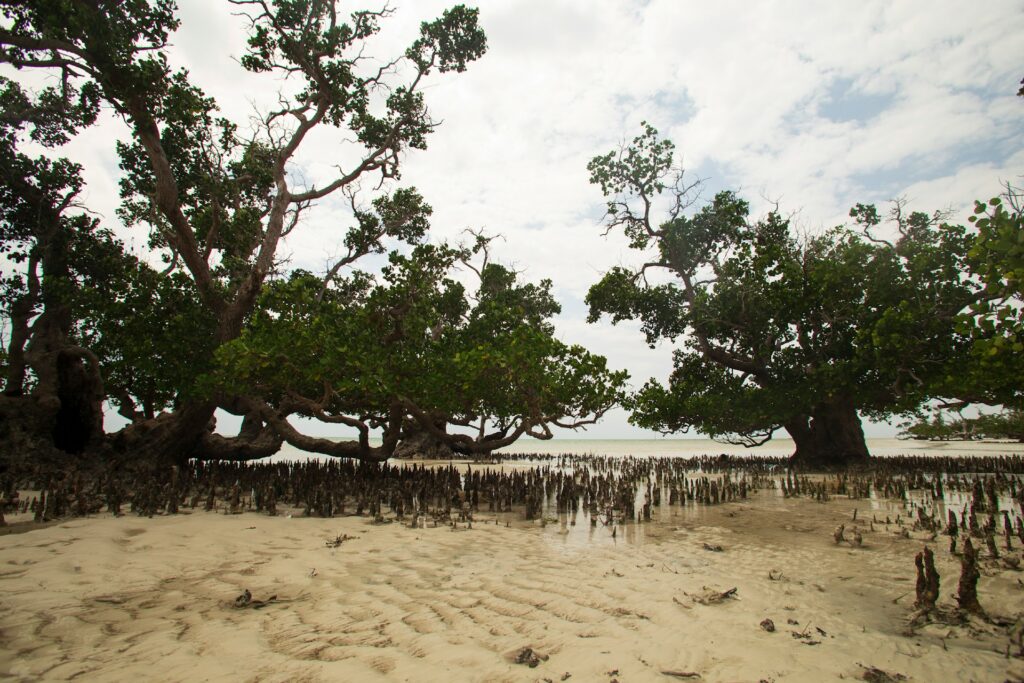
Mangroves are living monuments. Their roots, as dense as labyrinths, slow down the waves and protect millions of people from storm surges and hurricanes; the tangled web of trunks and mud provides ideal nurseries for fish and crustaceans; the trees sequester carbon at rates up to five times higher than those of “on-land” forests. For years, they have been treated as a sort of no-man’s-land, an obstacle to development. Yet it is precisely there that a key part of the world’s coastal and climate security is at stake.
As in Indonesia, where deforestation to make way for aquaculture ponds has slowed. The tsunami served as a wake-up call: “The islands covered in mangroves were better protected,” recalls Zhen Zhang, lead author of a study that remapped coastal forests using Landsat imagery more sensitive to changes in canopy cover.
The Trauma of the Cyclone
In Myanmar, the curve declined following the 2016 national ban on deforestation and the devastation caused by Cyclone Nargis. In Brazil, new forests are emerging along rivers where nutrient-rich sediments fuel their growth. This also has a downside: deforestation and mining upstream wash nitrogen and nutrients into the rivers, with effects that—paradoxically—benefit the mangroves at the river mouths.
Furthermore, in West and Central Africa, mangroves are receding, affected by oil pollution and illegal logging. Tropical cyclones also remain a threat: the study documents years in which single events have swept away entire stretches of coastline, from Australia to the Caribbean.
Three Factors That Help
As mentioned, three factors have helped. First, conservation measures. Restrictions and protected areas are holding up, giving nature time to do its work. Second: technology. Global-coverage satellites, such as the Landsat constellation, detect changes in vegetation cover that were previously invisible and allow us to accurately measure where gains and losses are occurring. Third: natural regeneration. Restoration programs help, but the data suggest that the bulk of the recovery comes from spontaneous regrowth on abandoned or minimally disturbed land.
In short, there’s no need to spend money; it’s better to protect the coastlines by leaving room for the tides and rising sea levels, and avoiding the practice of caging the coastlines between walls and roads that strangle the ecosystem. This is also because mangroves are local economies: fishing nets, aquaculture, and slow tourism. If conservation efforts do not include those who live among the roots and canals, they will fail. Community-based initiatives in Southeast Asia show that shared management reduces poaching, improves water quality, and increases fishing yields.