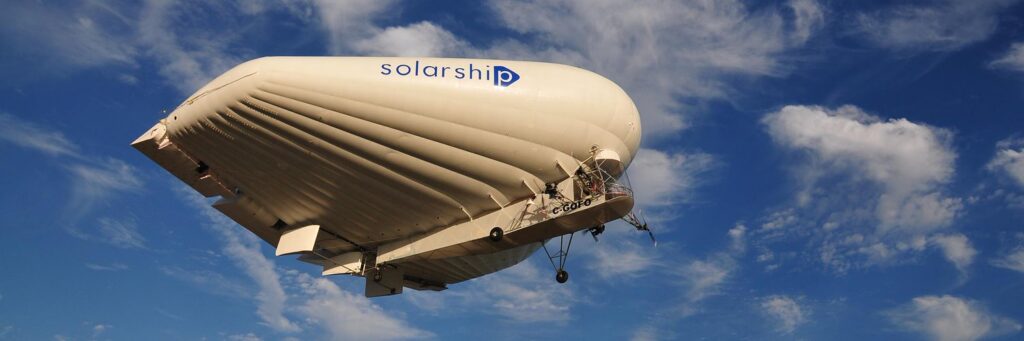
Imagine a one-hundred-meter dirt runway, a village beyond the end of the asphalt, and an airship that slowly lifts off the ground, and goes up silently thanks to solar panels and electric motors. The blimp makes a lot of scene, is super spectacular, and works hard: it lifts bulky loads, consumes little fuel, and doesn’t need airports. That’s where the gamble of the lighter than air becomes relevant again, between aviation decarbonization and logistics in the holes in the map.
Airships have existed for a century or more. Of course, so far they have lost the game of air transport of people and things because they are less maneuverable and faster than airplanes, and especially because they are more dangerous. The thunderous explosion of the Hindenburg in New York in 1937 has remained in history and the collective imagination. In recent years, however, they have made a comeback, thanks to lighter engines, efficient solar cells, better batteries, electronic thrust control, and more rational construction.
Two pivotal projects
Solar Ship, born in Canada, has spent a long season of trials and accidents to arrive at two pivotal projects: electric balloons capable of short takeoff and landing, designed for low-speed missions where autonomy, control and cost matter. The goal is to open access corridors to places without infrastructure, bringing aid, medical personnel, cargo and all sorts of bulky materials. Places where a truck won’t get and a helicopter costs too much.
Solar Ship is the creature of Jay Godsall. Growing up in Canada in a family accustomed to flight and speed, since he was a boy he has been obsessed with the idea of using solar-powered airships to connect remote territories. Turning an intuition into a company took time and failure, both financial, as in the 1990s, and engineering, like the prototype that crashed to the ground in 2008. It tried long and stubby shapes, narrower and wider fuselages, until 2014, when its“Caracal” powered by two 30-kilowatt electric motors managed to lift a 1.8-ton load, taking off and landing in the space of a soccer field. The test ended in a crash and some injuries to the pilots, but Goodsall did not give up.
Docile in slow flight
In slow flight, Solar Ship’s airships are docile. The difficulty comes with moving mass, which demands absolute balance. After 14 flight campaigns on as many prototypes, the company has narrowed its main projects to two. The key step is regulatory approval, which Solar Ship aims to support with demonstration missions.
An around-the-world flight with the Tsorocopter, designed to carry up to 12 tons at low speed with fine control, is planned for 2027. If the itinerary succeeds, the company plans to start operations in Africa within the year. A larger hybrid airship is expected to take off in 2028, for larger loads and a wider range.